

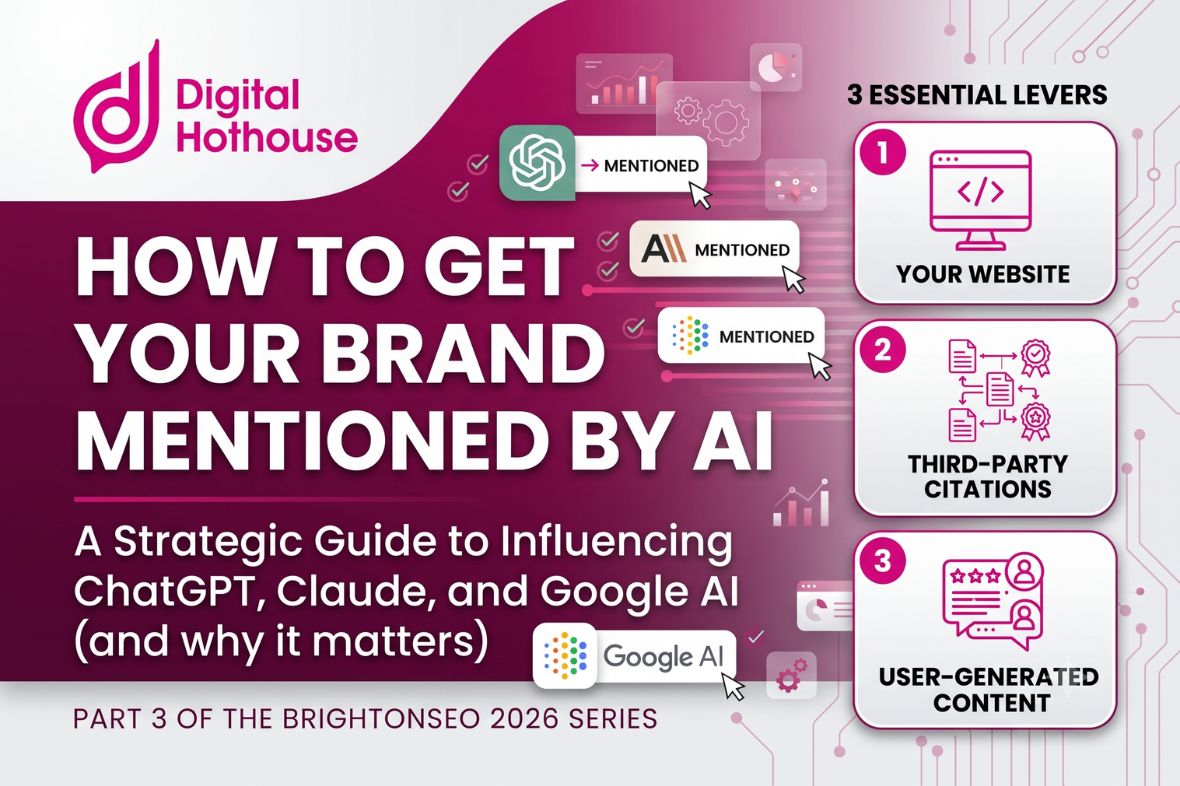
Part 3 in our BrightonSEO 2026 series. Catch up with the hub post and Part 2 on why your traffic is falling if you haven’t already.
Carrying on our series of posts based on our experiences and learnings at BrightonSEO, the next topic that was covered in-depth at the conference, and one that has been at the forefront of our efforts over the past 6–8 months, is how to get your brand mentioned in ChatGPT, Claude, Gemini, Perplexity and AI Overviews.
Whilst our BrightonSEO hub post and subsequent follow-up have both leaned heavily into the impact these platforms are having on organic traffic, they are becoming an essential part of our drive to build brand awareness, drive visits and ultimately, drive sales and revenue for our clients.
Whilst they may be seemingly taking away traffic from websites, the traffic they are driving, as we have previously highlighted, is converting at a much higher level than other channels, making these platforms highly valuable both in terms of raising brand awareness and ultimately, in growing our clients’ businesses.
So the question is: what does it actually take to get your brand in front of someone asking an AI assistant about your category? How does it work, what influences it, and what can you realistically do about it? BrightonSEO gave us a lot of answers. Here’s what you need to know.
First, Understand What You’re Actually Dealing With
Before we get into tactics, it’s worth understanding how AI platforms actually decide what to say about a brand, because it’s quite different from how traditional search ranking works, and misunderstanding the mechanism leads to misplaced effort.
Large language models like ChatGPT, Claude, and Gemini are trained on enormous datasets pulled from across the internet – websites, news articles, Reddit threads, YouTube transcripts, forums, reviews, social media, and much more. They don’t retrieve a page and display it the way Google does. Instead, they learn patterns from everything they’ve consumed during training, and they synthesise answers based on those patterns.
This means your “ranking” in an AI platform is not a single, controllable variable. It’s the cumulative result of how your brand is represented across every source the model has ever been trained on. If your brand appears frequently, consistently, and positively across many credible sources – your website, press coverage, reviews, community platforms, third-party directories – the model builds a stronger, more confident representation of who you are. If you’re mostly just present on your own website, your representation is thin.
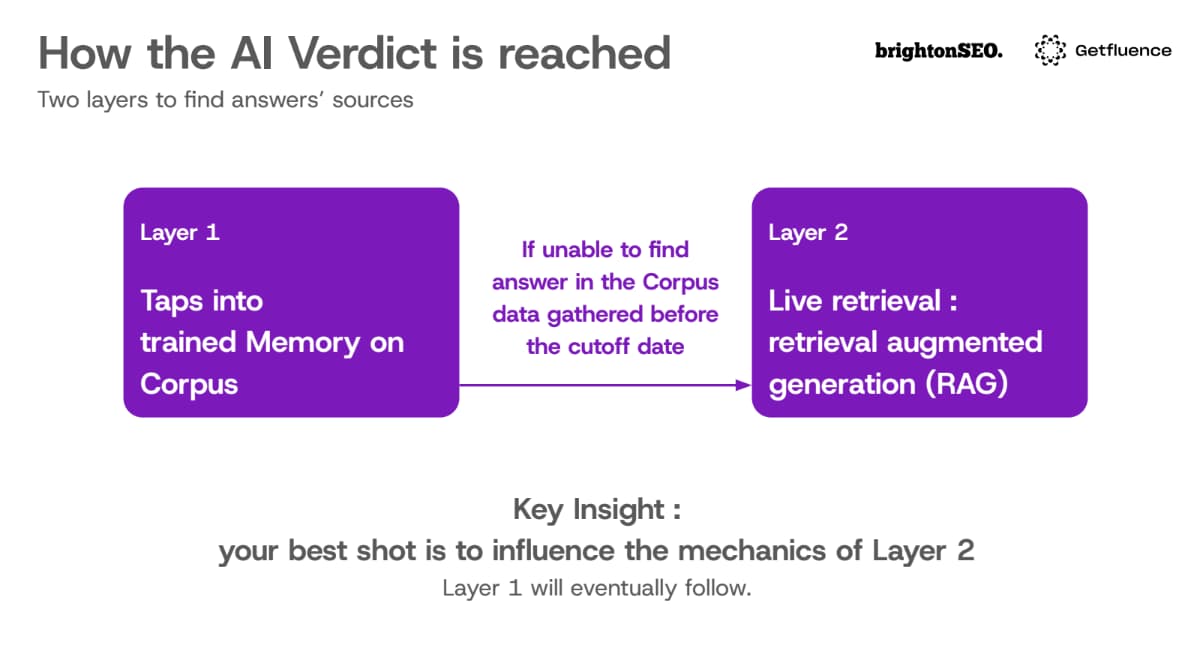
Christian Desert from Getfluence put it clearly in his BrightonSEO session on GEO (Generative Engine Optimisation): there are fundamentally two ways your brand can appear in an AI answer. The first is via training data – the model already knows who you are because it was trained on content that mentions you. The second is via RAG (Retrieval-Augmented Generation) – the AI pulls live content from the web at the moment of the query to supplement its answer. These two pathways require different strategies, and both matter.
Paul’s take:“The RAG distinction was one of the most practically useful things I heard across the whole conference. If you know which queries are triggering live web lookups – typically time-sensitive, local, or rapidly evolving topics – you can prioritise those in your content strategy because real-time content has a faster impact than waiting to influence the next training cycle. Christian Desert made the same point in his session: RAG-triggering queries are the highest-influence opportunity for brands right now.”
The Statistic That Should Change Your Strategy
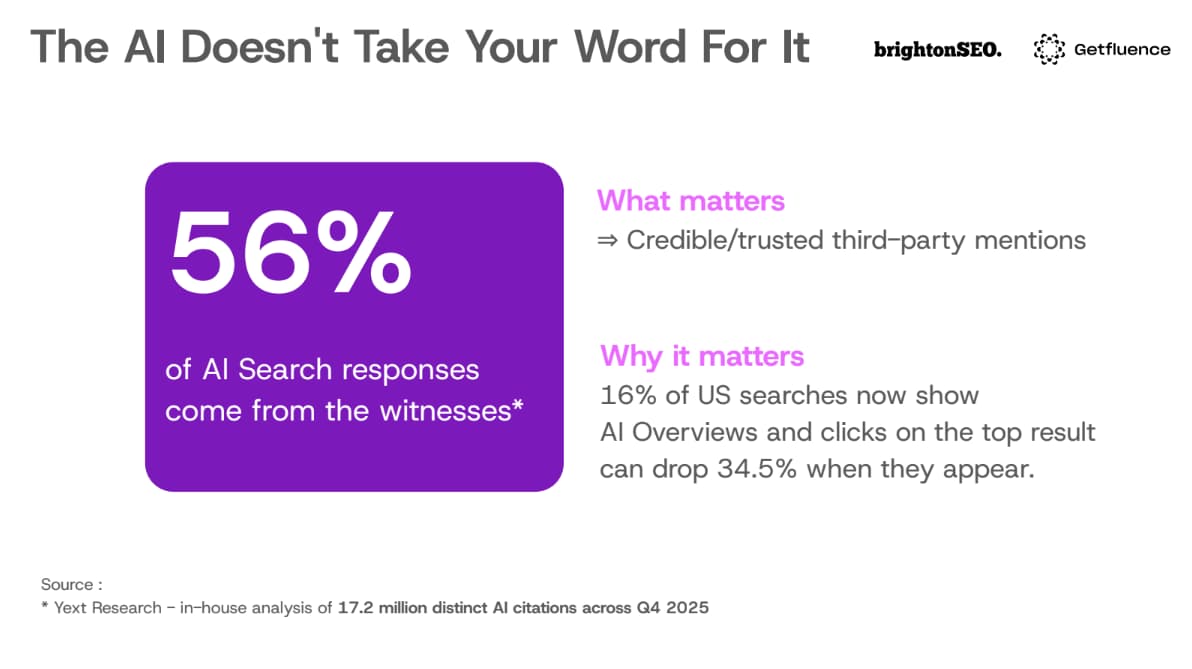
Christian Desert’s session at BrightonSEO delivered the single most consequential number of the whole conference for anyone thinking about AI visibility:
56% of AI visibility influence comes from external sources. Your own website accounts for less than half.
Read that again. Even if your website is technically perfect, your content is outstanding, your schema markup is flawless, you’re still only influencing less than half of what determines whether an AI platform mentions you. The majority of your AI presence is built from everything that exists about you across the rest of the web.
This isn’t a reason to abandon your website. A well-structured, technically sound website remains the essential foundation. But it is a very clear signal that a brand visibility strategy for 2026 needs to extend far beyond your own domain.
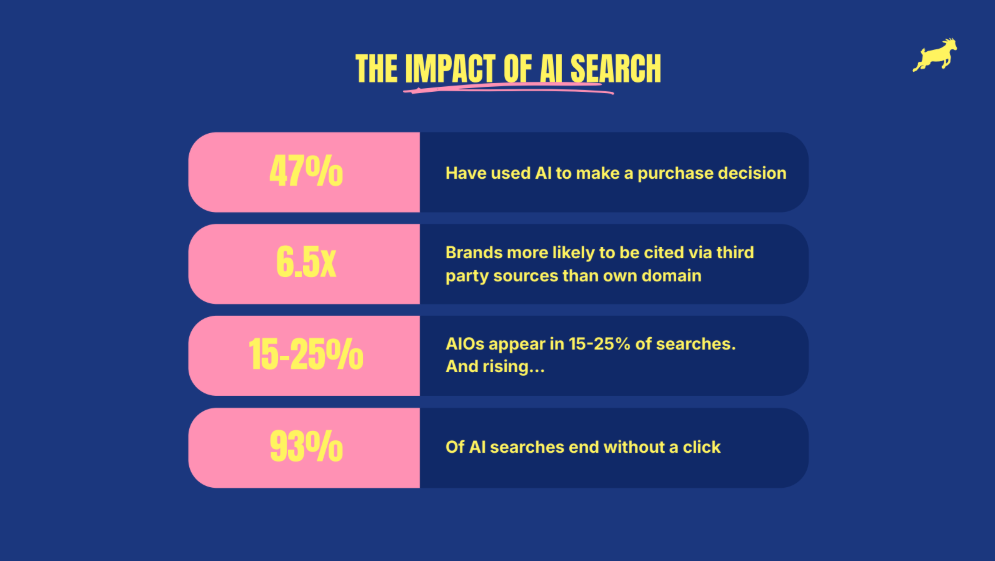
Jack Lingard (Anything is Possible) reinforced this from a different angle: being cited in AI platforms is 6.5 times more likely if you are already cited in third-party sources. Not slightly more likely. Six and a half times more likely. Third-party citations aren’t a nice-to-have in an AI world. They are the primary lever.
The Three Levers That Actually Move the Needle
Based on everything from BrightonSEO and from what we have been testing with our own clients over the past several months, there are three distinct areas you need to be working on simultaneously. Think of them as the three legs of a stool: you can balance on two for a while, but you’ll only be stable with all three.
Lever 1: Your Own Website (The Foundation)
Your website may be less than half the picture, but it’s still the piece you have complete control over, which makes it the logical starting point. The question is not whether your website matters – it does – but whether it’s actually doing its job as a source that AI can read, understand, and trust.
Several technical issues came up repeatedly across sessions at BrightonSEO that directly impact whether AI can even access your content:
JavaScript rendering is one of the most common and damaging. Janaina Barreto-Romero (Oncrawl), who specialises in AI crawl analysis, highlighted that if your website relies heavily on client-side JavaScript to render content, meaning the text and information only appear after JavaScript has executed in a browser, AI crawlers often cannot see it at all. Unlike Google’s crawler, which has become progressively better at rendering JavaScript over the years, many AI crawlers behave more like the early Google bots of 2012: they fetch the raw HTML and move on. If your key content only appears after JavaScript runs, it may simply not exist from an AI’s perspective.
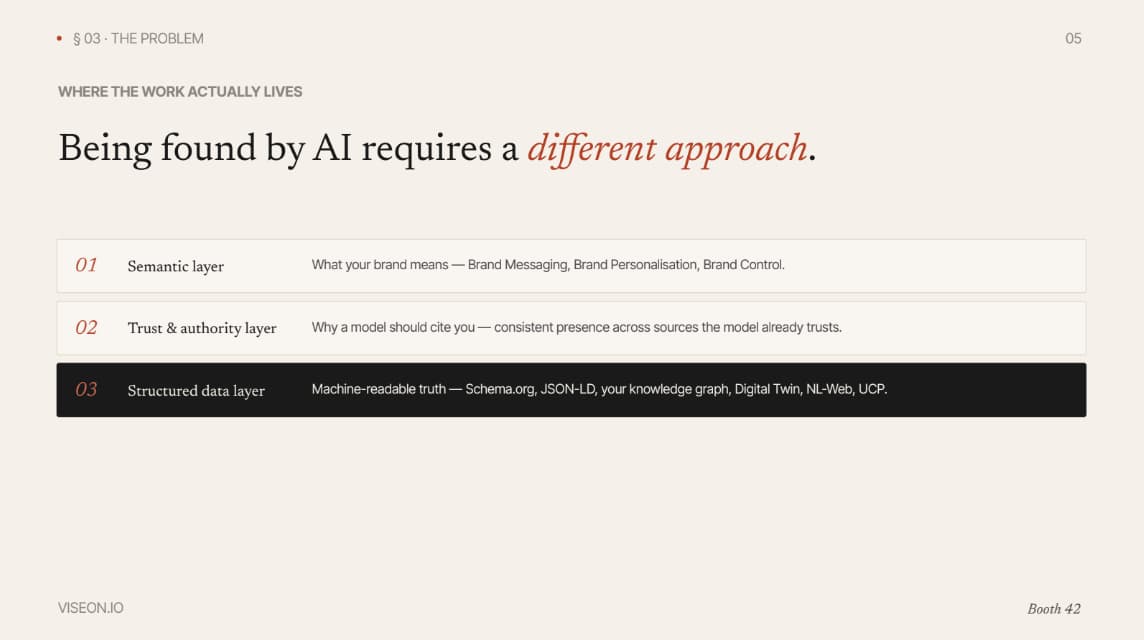
Structured data and schema markup remain one of the most reliable on-site signals you can send. Alex McKenna (Viseon.io) and Alex Moss (Yoast/Firecask) both emphasised this, not because schema markup guarantees you’ll be cited, but because it removes ambiguity. When you use structured data to declare what your business is, who it serves, where it’s located, what it offers, and how to contact it, you’re giving AI systems a pre-packaged, machine-readable description that’s easy to incorporate confidently into an answer.
Core Web Vitals and basic crawlability still matter here too. Janaina’s log file analysis work has shown that AI crawlers follow similar rules to search engine crawlers when it comes to page speed and technical accessibility. A slow, difficult-to-crawl site is deprioritised.
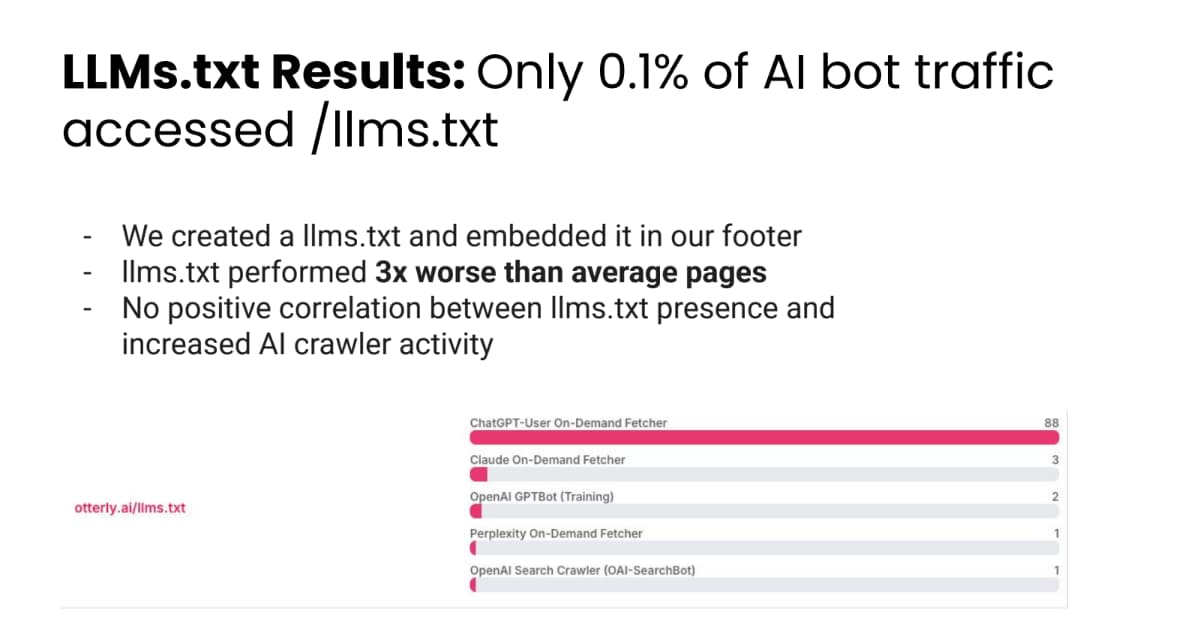
One thing that emphatically does not work: LLMs.txt files. Thomas Peham (Otterly.ai) shared his own test results, and they were unambiguous – 0.1% of AI bot traffic accesses LLMs.txt files, with no measurable positive correlation to visibility. If you’ve been told to create one of these as your AI optimisation strategy, the data suggests you’d be better off spending that time elsewhere.
Lever 2: Third-Party Citations (The Amplifier)
This is where the biggest gains are available, and where most brands are significantly underinvested. Given that 56% of AI visibility comes from external sources, and that being cited in third-party sources makes AI citation 6.5 times more likely, building your external presence isn’t optional; it’s the strategy.
What counts as a valuable third-party citation for AI visibility purposes? Think of it in layers:
Editorial media coverage – articles in news publications, industry blogs, trade press, and online magazines that mention your brand, describe what you do, quote your team, or reference your products. Thomas Peham’s testing at Otterly.ai found that distributing press releases to trusted media outlets produced measurable AI citation uplift within days of publication. The causal link between editorial mentions and AI visibility is clearer and faster than most brands expect.
Review platforms – Google Reviews, Trustpilot, Tripadvisor, product-specific review sites, and any platform relevant to your category. Sam Davis’s (Yext) session on LLM brand management made a point that surprised many people in the room: Claude, specifically, places significant weight on review response cadence as a trust signal. It’s not just whether you have reviews. It’s whether you actively respond to them, how quickly, and how consistently. If your last review response was eight months ago, that’s a visible signal to AI systems about how engaged and credible your brand is.
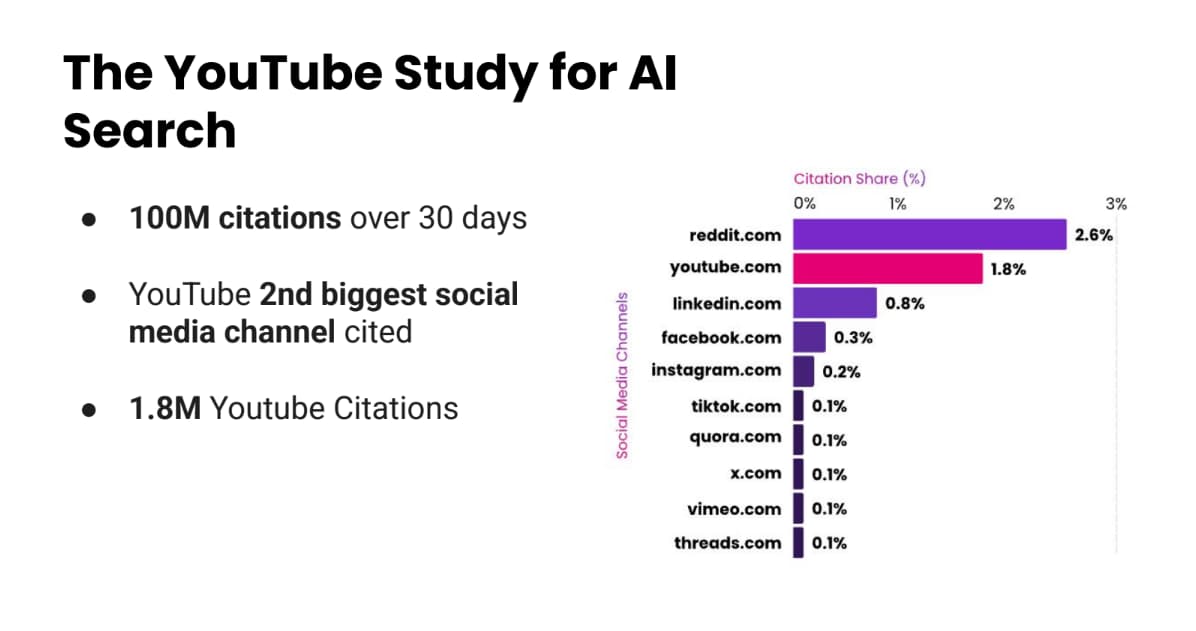
YouTube – Thomas Peham shared data showing that YouTube is the second most cited social platform in AI responses, after Reddit. If your brand has a YouTube presence, or if experts in your category are discussing your industry on YouTube, that content becomes part of the pool AI learns from. For businesses where video testimonials, demonstrations, or expert commentary are feasible, this is one of the higher-value channels to invest in.
Reddit and community platforms – multiple speakers across both days made the same observation: LLMs are deeply trained on Reddit. When someone asks an AI about a product, a service, or a brand experience, the AI is partly drawing on the kinds of conversations that happen on Reddit and similar forums. If your brand is being discussed positively there, or if it isn’t being discussed at all, that shapes what the AI knows. Darko Brzica (PressWhizz) recommended actively building a presence on Quora, Reddit, and relevant forums as a long-term AI visibility investment.
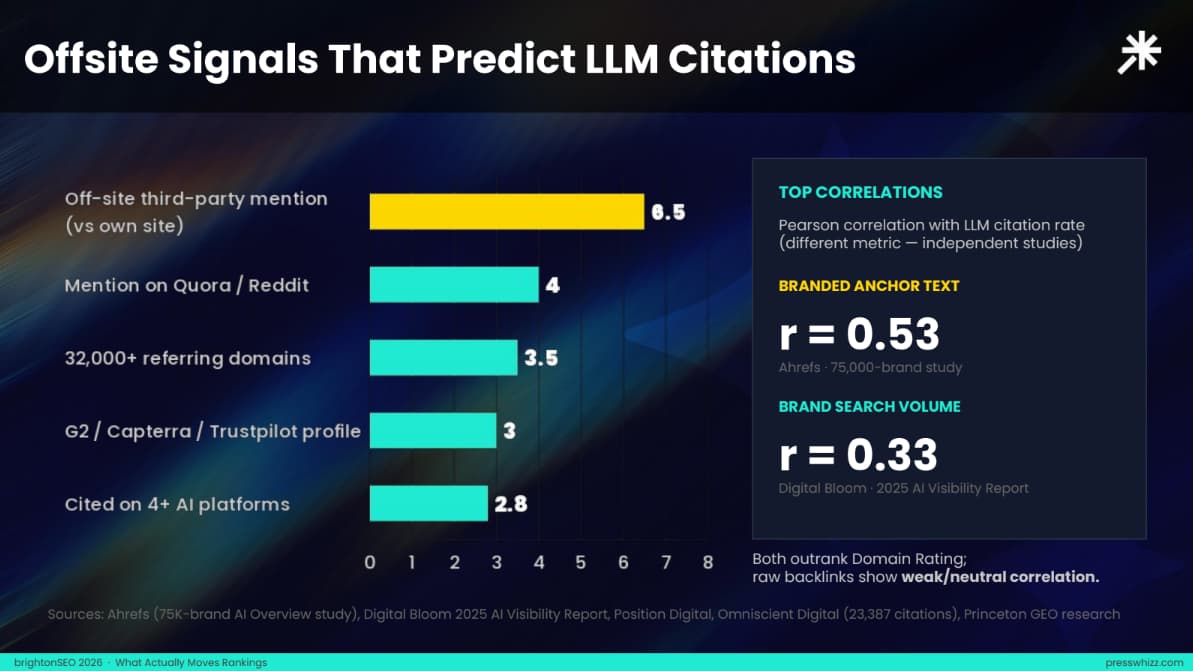
Professional and validation directories – Trustpilot, Capterra, G2, relevant industry directories, and professional body listings. Darko’s session on entity architecture highlighted that these kinds of third-party validation profiles are directly cited by LLMs as part of how they build confidence about a brand’s legitimacy. A presence on the right directories in your sector isn’t just a link-building exercise anymore. It’s infrastructure.
Paul’s take:“The Getfluence platform was mentioned by Christian Desert as a practical tool for placing editorial content in trusted publications – essentially a marketplace that connects brands with publishers. It’s something we’re exploring as a way to accelerate third-party citation building for clients who want to move faster than a traditional PR programme allows. Well worth a look for any business that wants to build AI visibility quickly.”
Lever 3: User-Generated Content (The Trust Signal)
The third lever is the one brands often feel least in control of, but it’s also among the most influential. User-generated content: reviews, testimonials, social mentions, forum posts, and any other content created about you by people who aren’t on your payroll.
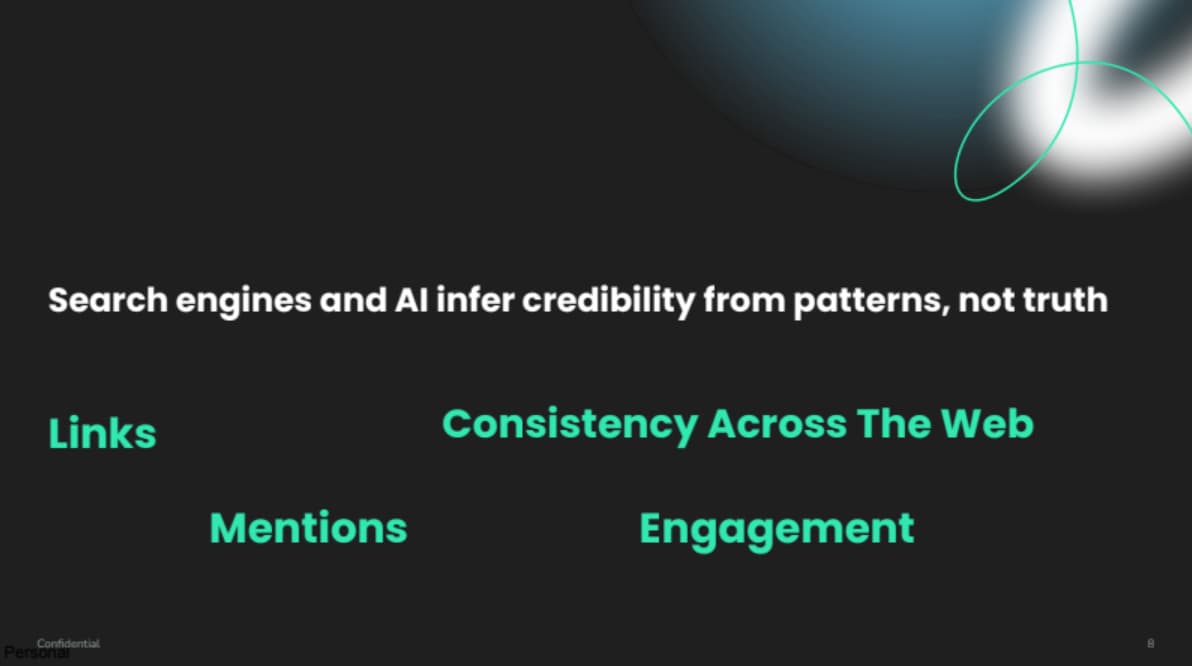
Sean Barber, SEO Manager at Macmillan Cancer Support, put it in a way that’s stuck with me since BrightonSEO: AI infers credibility from patterns across the web, not necessarily from truth. What this means in practice is that AI systems build their picture of a brand the same way a human who has never met you might; by reading what other people say. If the pattern of what people say is positive, consistent, and widespread, the AI’s representation of your brand will reflect that. If the pattern is negative, patchy, or absent, the AI’s confidence in your brand drops accordingly.
Janaina Barreto-Romero’s point on this was the one that generated the most visible discomfort in the session: old reviews and old Reddit threads are still being cited by LLMs today. Not recent reviews. Not the three-star review from last month that you’ve since resolved. A thread from 2021 in which someone described a poor experience with your product. An old Trustpilot review that was technically incorrect but was never challenged. These things haven’t gone away and AI may be surfacing them to potential customers right now, regardless of how much your business has improved since.
This is why UGC isn’t just a marketing channel. It’s a brand reputation management discipline with direct commercial implications.
How to Audit Your AI Brand Visibility Right Now
One of the most useful things we took from BrightonSEO was confirmation that you can start assessing your AI brand visibility immediately, without any specialist tools, in under 30 minutes. Here’s a straightforward process we run for our clients.
Step 1: The basic mirror test. Open ChatGPT, Claude, Gemini, and Perplexity. In each one, ask the following:
- “What is [your brand name]?”
- “What does [your brand name] offer/sell?”
- “Is [your brand name] a good [type of business]?”
- “What do customers say about [your brand name]?”
Record what each platform says. Is it accurate? Is it positive? Does it mention the right products, locations, or services? Does it mention competitors alongside you, and if so, how do you compare? Is there anything factually wrong or outdated?
Step 2: Category queries. Now ask without using your brand name at all:
- “What are the best [your category] in [your location]?”
- “Who are the leading [your type of business] for [your target customer]?”
- “What should I look for when choosing a [your product or service]?”
Does your brand appear? If it does, in what context and with what framing? If it doesn’t, which brands do and what do they have that you don’t?
Step 3: Sentiment and source check. Enable web browsing in ChatGPT and Perplexity (where available) and ask the category questions again with browsing turned on. This is the RAG layer – the live web lookup – and it may produce different results from the training-data layer. Pay attention to which sources the AI cites when it does use web lookups. Those are the publications and platforms that matter most for your category.
Step 4: Review your external presence. Check Google Reviews, Trustpilot, your most relevant directory listings, and your Reddit mentions (a quick search for “[your brand name]” on Reddit will surface most of it). Are there negative threads or reviews that haven’t been responded to? Are there factual inaccuracies about your business that no one has ever corrected?
Step 5: Entity consistency check. Search for your brand name across Google Business Profile, LinkedIn, Wikipedia or Wikidata, and any major directories in your sector. Is the brand name spelt and formatted consistently? Are the descriptions, services, and locations accurate and up to date? Inconsistency between these sources reduces the AI’s confidence in its own understanding of your brand, a concept Darko Brzica described as the entity confidence score.
The Tools Worth Knowing About
A few platforms came up repeatedly in sessions when speakers discussed monitoring and improving AI visibility:
SE Ranking was recommended by Judith Lewis as useful for tracking LLM visibility and sentiment – how your brand is being represented across AI platforms over time, and whether that representation is improving.
Waikay was highlighted specifically for prompt tracking – the ability to understand which prompts are returning your brand, and which aren’t.
Oncrawl (and similar log file analysis tools) can show you which AI crawlers are visiting your site, how frequently, and which pages they prioritise, giving you a much clearer picture of which of your pages are likely being used as citation sources.
Kompote.ai was mentioned by Nick Beck as a tool for AI Inclusion and AI Advocacy tracking – still relatively new, but worth exploring for businesses where AI brand management is a priority.
We’re currently evaluating several of these tools ourselves and will share our findings as we go. The monitoring landscape for AI visibility is still developing rapidly, and the “right” toolset in 2026 will almost certainly look different by 2027.
Paul’s take:“The honest answer is that none of these tools are perfect yet. The more important shift is in mindset – regularly checking how AI platforms represent your brand should become as routine as checking your rankings or your review score. You don’t need a tool to start doing that. You just need to make it a habit.”
Start Here: Five Practical Steps
If you’re reading this and wondering where to begin, here are five actions you can take right now, in rough order of priority:
- Run the mirror test above. Understand where you stand before you try to change anything. You can’t improve what you haven’t measured.
- Audit and respond to every outstanding review. Go back through your Google reviews, your Trustpilot, your product reviews, wherever customers have left feedback, and make sure every review has a response. Then build a process that ensures no new review goes unanswered for more than a few days.
- Check your external presence for accuracy and consistency. Your Google Business Profile, LinkedIn company page, any relevant directories. Is everything correct, current, and consistent? Fix what isn’t.
- Identify your three most important third-party citation opportunities. Based on your category and audience, which external platforms, publications, or communities are most likely to be read by AI systems? Start with those, whether that’s an industry directory, a sector publication, a review platform, or a community forum.
- Have a conversation with us. We’ve been doing this work for our clients for the past 6–8 months and we have a clear view of what’s working, what isn’t, and what the priority actions are for different types of businesses. If you’d like a straightforward assessment of your current AI brand visibility and what it would take to improve it, get in touch, we’d love to help.
Coming Up Next in This Series
In the next post, we’ll turn to content strategy – specifically how to build content that an AI platform will want to cite, starting with a deep understanding of your audience rather than a keyword spreadsheet. Sophie Coley, Chima Mmeje, and Daniel Liddle all had a lot to say on this at BrightonSEO, and it’s one of the more counterintuitive shifts in how we now think about content creation.
Gavin is Digital Hothouse’s SEO lead. He attended BrightonSEO 2026 with Director Paul Thornton.