

Back in May, Paul and I flew to Brighton for the world’s biggest SEO conference. We came home with pages of notes, a genuinely different way of thinking about what “SEO” means in 2026, and a promise to write it all up properly rather than let it gather dust in a shared Google Doc. Three months and seven blog posts later, that promise is kept, and it feels like the right moment to draw a line under the series, take stock of what we have learned since, and tell you what comes next.
Because there is a next. What started as a conference recap has become the foundation for a proper 12-month content and growth plan, one built entirely around the themes that came out of Brighton. This post is the hinge between the two: a short recap of the series so far, and an introduction to the roadmap we are now committing to publicly.
A Quick Recap: The Seven-Part BrightonSEO Series
If you have been following along, feel free to skip ahead. If this is the first post of ours you have landed on, here is what we covered, in order.
We opened with What BrightonSEO 2026 Tells Us About the Future of Search, the hub post covering the eight themes that ran through every session Paul and I attended, from the uncomfortable 93% zero-click statistic to the reassurance that the technical fundamentals of good SEO have not actually changed.
From there we went deeper. Why Your Website Traffic Is Falling, And Why That Might Be Fine tackled the anxiety around declining organic sessions and introduced the idea that smaller, more qualified traffic (AI-referred visitors convert at 4.4 times the rate of traditional organic traffic) can be a better outcome than a bigger, noisier number.
How to Get Your Brand Mentioned by ChatGPT, Claude and Google’s AI followed, laying out the statistic that has shaped most of our thinking since: 56% of AI visibility influence comes from external sources, not your own website. We covered the three levers- your site, third-party citations, and user-generated content- that determine whether an AI platform knows who you are.
The End of Content for Content’s Sake looked at what audience-first content actually means in practice, using Sophie Coley’s audience facets framework and Daniel Cartland’s sobering case study of a blog generating half a client’s traffic and just 7% of their revenue.
Technical SEO in the Age of AI brought Paul’s expertise to the fore, covering JavaScript rendering, Core Web Vitals, structured data, and the entity confidence score, plus a firm debunking of the LLMs.txt hype (0.1% of AI bot traffic actually reads one, for what it’s worth).
Why Being Talked About Online Has Never Mattered More explored the convergence of E-E-A-T, digital PR, and brand narrative, including the finding that hyper-targeted PR outreach of 25 to 50 personalised pitches outperforms mass emailing by a factor of 17.
And finally, How to Prove the Value of SEO in a World Where Clicks Are Declining closed the series with an honest look at the measurement crisis facing our industry, and the frameworks (Presence, Preference, Performance chief among them) we are now testing with clients.
Seven posts. Roughly twenty thousand words between us. If you’ve read all of them, you genuinely do deserve that badge and strong coffee we promised at the end of the last one.
What We Have Learned Since Hitting Publish
Writing the series was useful in itself. It forced Paul and me to synthesise two intense days of conference sessions into something we could actually act on, rather than a stack of notes we would never revisit. But the more interesting learning has come since, from actually applying the frameworks to client accounts.
We have started separating blog traffic from commercial traffic in every client report (where relevant). We are building AI visibility snapshots into quarterly reviews, using the mirror test we described in the ChatGPT post. And we have had several genuinely difficult, genuinely useful conversations with clients about what “success” should look like when a top ranking no longer guarantees a click.
Paul’s take: “The thing that has stuck with me most since we published this series is how many of the conversations it has opened up with clients who read it themselves before we even brought it up. That was not something we necessarily expected from a conference recap. It has been a proper trust-building exercise, not just a content exercise.”
Introducing the Roadmap: Five Pillars, Twelve Months, Fifty-Two Posts
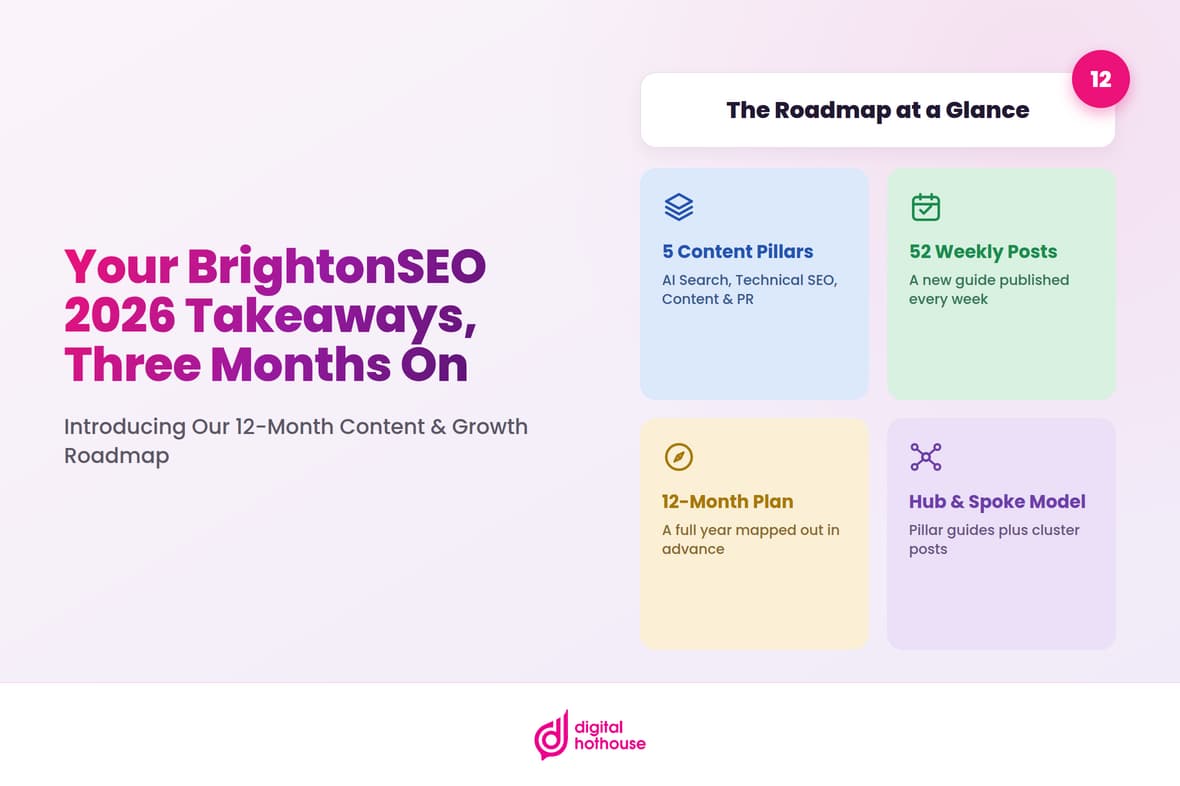
Here is the announcement this post exists to make. Over the next twelve months, we are turning the themes from the BrightonSEO series into a full pillar-and-cluster content programme, structured around five core pillars that map directly onto what we learned in Brighton.
The five pillars are:
AI Search and Generative Engine Optimisation (GEO), extending Posts 1 and 3 of the recap series into a full framework for earning citations inside ChatGPT, Claude, Google AI Overviews, and Perplexity. The pillar page for this one is already live: The Complete Guide to Generative Engine Optimisation is our most comprehensive piece to date, and it is the hub every cluster post in this pillar will link back to.
Technical SEO for the AI Era, building on Post 5 with a full checklist covering crawlability, Core Web Vitals, schema markup, and platform-specific guidance for Shopify, WordPress, and custom builds.
Audience-First Content Strategy, extending Post 4 into a repeatable framework for building content around real customer questions rather than keyword volume, using this very series as a live worked example of the hub-and-spoke model in action.
Digital PR and Brand Authority, building on Post 6 into a practical playbook for earning genuine media coverage, structuring outreach campaigns, and understanding how digital PR now feeds AI visibility directly.
Proving SEO and Content ROI in a Declining-Click World, extending Posts 2 and 7 into a complete measurement and reporting framework for demonstrating value when clicks alone no longer tell the whole story.
Each pillar will publish as an in-depth hub page over the coming weeks, followed by roughly nine cluster posts apiece, rotated across all five pillars for variety rather than published in one long block. By this time next year, we will have published fifty-two posts covering everything from llms.txt myths to building a customer avatar to setting realistic SEO budgets for your business.
Why We Are Doing This Publicly
We could have kept this roadmap internal and simply published the posts as they came. We are choosing not to for a fairly simple reason: transparency is genuinely one of our founding principles at Digital Hothouse, not a tagline. If you’re a business owner trying to work out whether your marketing team has the in-house capability to keep pace with a search landscape that is changing this quickly, or an SEO professional wanting a second opinion on how another agency is thinking about the next twelve months, we would rather show our working than keep it behind closed doors.
That also means holding ourselves accountable to a public schedule, which is no bad thing.
What You Can Expect Each Week
Every week for the next year, we will publish either a pillar hub page or a cluster post exploring one specific, practical angle within that pillar, always tied back to a real action you can take regardless of the size of your business or your budget. No post in this series will assume you have an enterprise budget or a dedicated in-house SEO team. Most of the businesses we work with do not, and that’s exactly who this roadmap is written for.
If you want every post the moment it goes live, rather than stumbling across them individually, then following us on LinkedIn is the easiest way to keep up. We will also be linking each new pillar and cluster post back to this roadmap as it publishes, so this page will effectively become the master index for the whole twelve months.
And if anything in the BrightonSEO series, or in the roadmap ahead, raises a question specific to your business, get in touch. That conversation, more than any individual blog post, is genuinely the point of all of this.
Frequently Asked Questions
What is BrightonSEO, and why does Digital Hothouse keep referencing it?
BrightonSEO is the world’s largest SEO conference, held in Brighton, England. Our Director Paul Thornton and SEO lead Gavin Hirst attended in May 2026, along with the Digital PR Summit the week prior, and this roadmap is built directly on the themes and data presented there.
What are the five content pillars in the 12-month plan?
AI Search and Generative Engine Optimisation, Technical SEO for the AI Era, Audience-First Content Strategy, Digital PR and Brand Authority, and Proving SEO and Content ROI in a Declining-Click World.
How often will new posts be published?
Weekly. Weeks 2 to 6 cover the five pillar hub pages, and weeks 7 to 52 cover 46 cluster posts rotated across all five pillars.
Do I need to have read the original BrightonSEO series to follow the roadmap?
No, though we would recommend it if you have the time. Each pillar page is written to stand alone, and links back to the relevant recap post for anyone who wants the fuller context.
Is this content relevant if I do not have an in-house SEO team?
Yes, that is specifically who it is written for. Every post in this series is built to give small and medium businesses practical, actionable guidance, whether you are managing search yourself or trying to work out whether you need outside help.
Gavin is Digital Hothouse’s SEO lead. He attended BrightonSEO 2026 with Director Paul Thornton.