

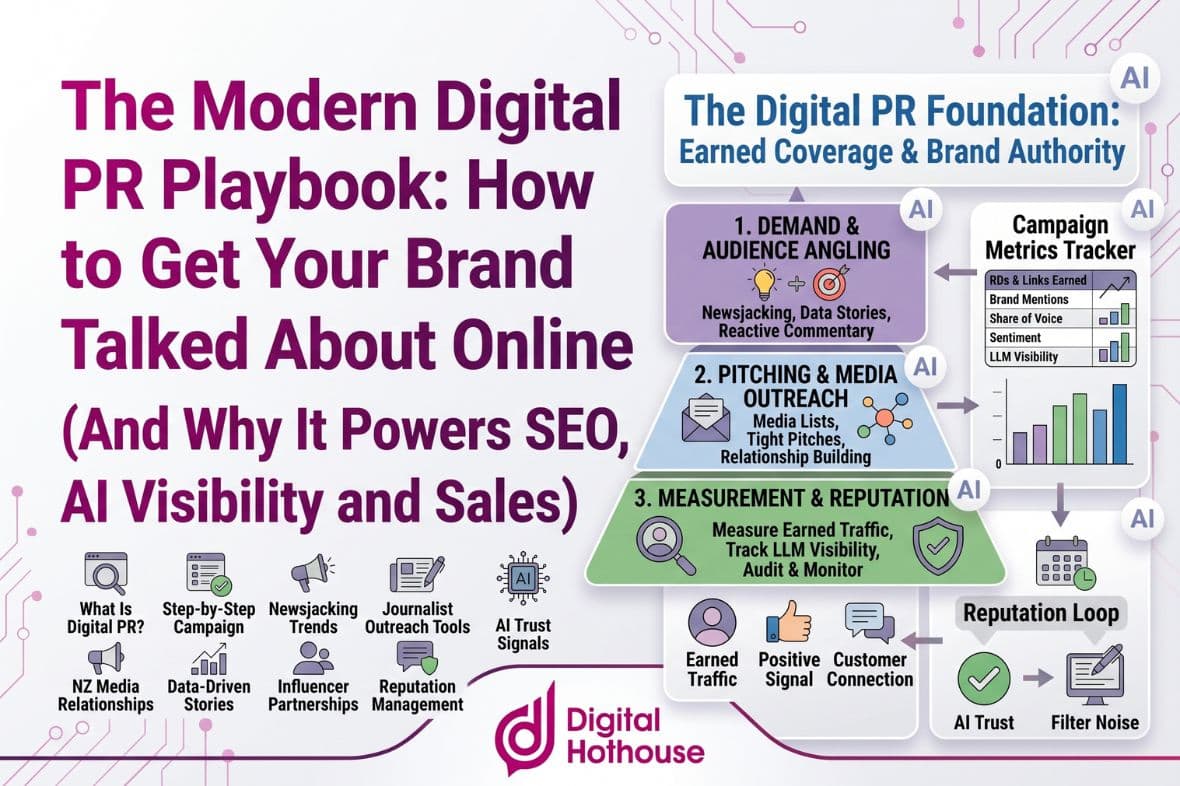
Coverage Is the New Currency
Ask ten business owners what digital PR means and you’ll get ten different answers, most of them wrong. It isn’t “getting mentioned in the news.” It isn’t link building with better manners, either. And it definitely isn’t something you switch on for a fortnight before a product launch and switch off again once the backlinks land.
This is the fourth guide in our 12-month content programme, following our pillars on Generative Engine Optimisation, technical SEO for 2027 and audience-first content strategy. It also returns to a theme we raised early in our BrightonSEO 2026 recap series: being talked about online, genuinely, and by people who don’t work for you, has become one of the strongest signals a brand can send. To Google, to AI answer engines, and to the customer reading past the fold.
This guide covers what digital PR actually is and how it differs from link building and traditional PR, how to build a campaign from scratch, how newsjacking and data-driven PR work in practice, why digital PR now feeds directly into AI visibility, how to handle it when coverage turns negative, and a measurement framework that goes beyond counting backlinks.
What Digital PR Actually Is (And Why It Isn’t Link Building With Better Manners)
Digital PR means earning genuine coverage, citations and mentions in real publications, trade journals, niche blogs and platforms that wouldn’t accept a paid placement, a guest-post pitch or an unvetted contributor, with the goal of building brand awareness and driving referral traffic. The backlinks are a welcome side effect, not the point.
That’s close to how Search Engine Journal frames the distinction: digital PR treats coverage as a business outcome, tracked through traffic, brand awareness and sales, while traditional link building is often just “getting links from websites as a way to try and increase SERP rankings,” with no tracking of whether those links do anything else at all. Every good digital PR campaign tends to produce links. Not every link-building campaign produces PR.
Traditional PR sits on the other side of the same coin: press releases, media relationships and reputation management aimed at a broad audience, historically without a clean way to attribute a trackable digital outcome. Digital PR borrows traditional PR’s relationship-building and storytelling instincts and points them at SEO-relevant proof: referring domains, brand mentions, share of voice, alongside the press win itself.
Paul’s take: “The line I draw with clients is simple: if we can’t point to who read it, watched it or wrote about it, it isn’t PR, it’s just another link. We’ve turned down ‘link opportunities’ that would have taken an hour and kept a genuinely hard media pitch running for three weeks, because the pitch was still going to be there answering customer questions in a year and the link wasn’t.”
Building a Digital PR Campaign From Scratch: Angles, Media Lists and Pitching
Every campaign that earns real coverage starts with an angle strong enough to survive contact with a journalist’s inbox at 8am on a Monday. Search Engine Land’s roundup of practitioner campaigns groups the reliable ones into a handful of types: original data and research, interactive tools, reactive or newsjacked commentary, and seasonal timing. We’ll cover newsjacking and data-driven PR specifically in the next section.
The process itself, stripped back to essentials, looks like this:
- Find the angle before you think about the outlet. A genuinely newsworthy, surprising or useful finding will always out-perform a well-written pitch about nothing in particular.
- Build a media list around outlets your actual customers read, watch or follow, not a generic list of “top NZ media.” A trade publication with 8,000 relevant readers usually beats a mainstream masthead with 800,000 irrelevant ones, for both traffic and the quality of any resulting link.
- Pitch tight. One clear subject line, one paragraph explaining the story (not your company), and an offer of first access or an exclusive if the angle warrants it.
- Follow up once, not five times. Journalists are candid about how quickly a good pitch turns into a deleted one after too many nudges.
As reported by the campaigns themselves in Search Engine Land’s write-up, and not figures we’ve independently verified, results at the strong end of the scale include a data-driven study on US state tax burdens picking up 727 backlinks from outlets including The Washington Post, Yahoo and CNBC, and a newsjacked conservation stunt earning 227 backlinks from outlets like Mashable and CNN while lifting branded search by 27%. Treat these as illustrations of what’s possible at the top end, not a benchmark for a first campaign; most NZ businesses will be working with smaller budgets, smaller media lists and correspondingly smaller (but still valuable) results.
Newsjacking, Data-Driven PR and Reactive Commentary
These three tactics cover most of what a lean in-house team or agency can realistically run without a dedicated research budget.
Newsjacking means reacting to a trending story, news cycle or cultural moment with genuinely relevant, credible commentary or a tie-in campaign, fast enough to still be timely. As per PR Lab, speed and relevance both matter: a tenuous link to a trending topic, bolted on purely to ride the search volume, tends to read as opportunistic and gets ignored by journalists for exactly that reason.
Data-driven PR turns a business’s own data, or a small original survey, into a story a journalist couldn’t get anywhere else. Search Engine Journal groups these into a few repeatable formats: proprietary data analysis (mining data you already hold for a genuinely surprising finding), survey-based studies, expert roundups, and trend reports that track a metric over time. The common thread is that the story exists before the pitch does; you’re not inventing an angle to justify outreach, you’re reporting something true and letting the outreach follow.
Reactive commentary is the lowest-effort, highest-frequency tactic: responding to journalist requests for expert quotes on stories already in motion. It used to run almost entirely through HARO, however, there are now more players in the market and more opportunities as we cover in the next section.
Journalist Outreach Tools and Building Real NZ Media Relationships
If you last ran a reactive PR campaign a couple of years ago, it’s worth knowing the landscape shifted twice. HARO (Help a Reporter Out) was wound down under Cision’s ownership in December 2024, rebranded Connectively at the time. Featured then acquired the platform and relaunched HARO in 2025, restoring its original name and its free, email-based model for both journalists and sources. So the short version for a briefing document: HARO is back, still free, and still worth using.
HARO isn’t the only free option worth running alongside it, either. Source of Sources (SOS), founded by HARO’s original creator Peter Shankman, runs on the same model: experts get up to three digest emails a day of journalist requests from a large network of outlets, and reply directly when they genuinely have something useful to add. Paid platforms like Qwoted sit alongside these as a more curated, subscription option. Different platforms tend to carry different requests, so running more than one at once (we use HARO and SOS) genuinely widens the net rather than duplicating it.
For New Zealand businesses specifically, tools only get you so far. A journalist who has had one genuinely useful, jargon-free comment from you six months ago is far more likely to come back than a cold pitch to a generic media list. We go deeper on identifying and building relationships with relevant NZ journalists and publications in an upcoming cluster post; the short version is that consistency and usefulness beat volume every time.
How Digital PR Feeds GEO: Brand Mentions as AI Trust Signals
We covered this properly in our GEO pillar guide, but it’s worth restating here because it changes how digital PR should be briefed and measured. AI answer engines weigh a brand’s relevance, authority and prominence across reputable third-party content when deciding what to mention, and that includes unlinked references, not just backlinks (iProspect; Meltwater). Semrush’s own analysis of roughly a million non-branded queries found brand mentions appearing in AI responses at meaningfully different rates by platform (its figures, from Semrush’s proprietary research rather than an independently verified study, were approximately 26% for ChatGPT, 39% for ChatGPT Search and 37% for Google AI Overviews).
The practical implication: a media placement that never links back to your site can still be doing real work for your AI visibility, provided it appears on a page LLMs are actually citing from. That’s a different brief to a traditional “we need the anchor text” link-building request, and it means digital PR and GEO should increasingly be planned together rather than as separate workstreams.
Paul’s take, from our GEO guide, still holds here: “The honest answer is that none of these tools are perfect yet. The more important shift is in mindset – regularly checking how AI platforms represent your brand should become as routine as checking your rankings or your review score.”
Reputation Management: When Coverage Turns Negative
The same visibility digital PR builds can work against you when the story isn’t a flattering one. A few practical steps, drawn from Go Fish Digital’s reputation management guidance, are worth having in place before you need them:
- Audit first. Search your own business name and review what’s actually sitting on page one and two before deciding anything needs fixing.
- Respond to negative reviews directly, briefly and without defensiveness: thank the reviewer, address the specific complaint where you reasonably can, and offer a direct contact route rather than arguing it out in public.
- Let genuinely positive coverage do the work of pushing down older negative results, by keeping it fresh (updated images, current information) rather than letting it go stale.
- Monitor continuously, not reactively, with a standing Google Alert (or equivalent) on your brand name so you hear about a problem from the tool, not from a client.
The connection back to digital PR is direct: a business with a track record of genuine earned coverage has more positive, authoritative content already in the search results to absorb a bad week, and existing journalist relationships to call on if a right of reply is needed. Reputation management is much easier when it isn’t the first time you’ve ever tried to get someone to write about you.
A Digital PR Campaign Calendar and Measurement Framework
Counting backlinks alone under-sells what digital PR is actually doing for a brand. Meltwater’s rundown of PR KPIs is a useful starting checklist; the ones we’d prioritise for an SME running its first structured programme are:
| Metric | What it tells you |
| Referring domains & links earned | The traditional SEO-facing output of a campaign |
| Brand mentions (linked and unlinked) | Total reach of the coverage, including citations that never link back |
| Share of voice | Your coverage volume relative to named competitors |
| Sentiment | Whether the coverage is helping or hurting, not just its volume |
| Earned traffic | Actual visits driven from the placements, not just potential reach |
| LLM visibility | How often your brand is surfaced in AI-generated answers for relevant queries |
On cadence: treat digital PR as an ongoing programme with a light always-on layer (reactive commentary, journalist relationship-building) plus two to four bigger campaigns a year built around a genuine data story, seasonal moment or product news. Review the metrics above monthly for trends, and quarterly for anything you’d report up to a business owner or board.
Supporting Guides in This Pillar
This page is the hub for the Digital PR pillar. As with our GEO, technical SEO and content strategy pillars, every cluster post below will link back here, and we’ll link out to each as it publishes:
- What Is Digital PR? A No-Nonsense Guide for Business Owners
- How to Build a Digital PR Campaign From Scratch (Step-by-Step)
- Newsjacking 101: How to Get Media Coverage by Reacting to Trends
- HARO and Journalist Outreach Alternatives in 2027
- How Digital PR Builds the Backlinks and Brand Mentions AI Models Trust
- Building Relationships with NZ Journalists and Publications: A Practical Guide
- Data-Driven PR: How to Turn Your Business Data Into Media Stories
- Influencer Partnerships vs Digital PR: What’s the Difference and Do You Need Both?
- Reputation Management: What To Do When Your Brand Gets Bad Press or Reviews
Being Talked About Isn’t Optional Anymore
SEO, AI visibility and sales are all downstream of the same underlying thing: whether real people, and increasingly real AI systems, are encountering your brand somewhere other than your own website. Digital PR is how you earn that, deliberately and honestly, rather than hoping it happens on its own.
Book a free Digital PR Discovery Call with Digital Hothouse. We’ll look at where your brand is (and isn’t) currently being mentioned, and build a campaign plan that fits your budget and your actual customers, not a generic media list.