

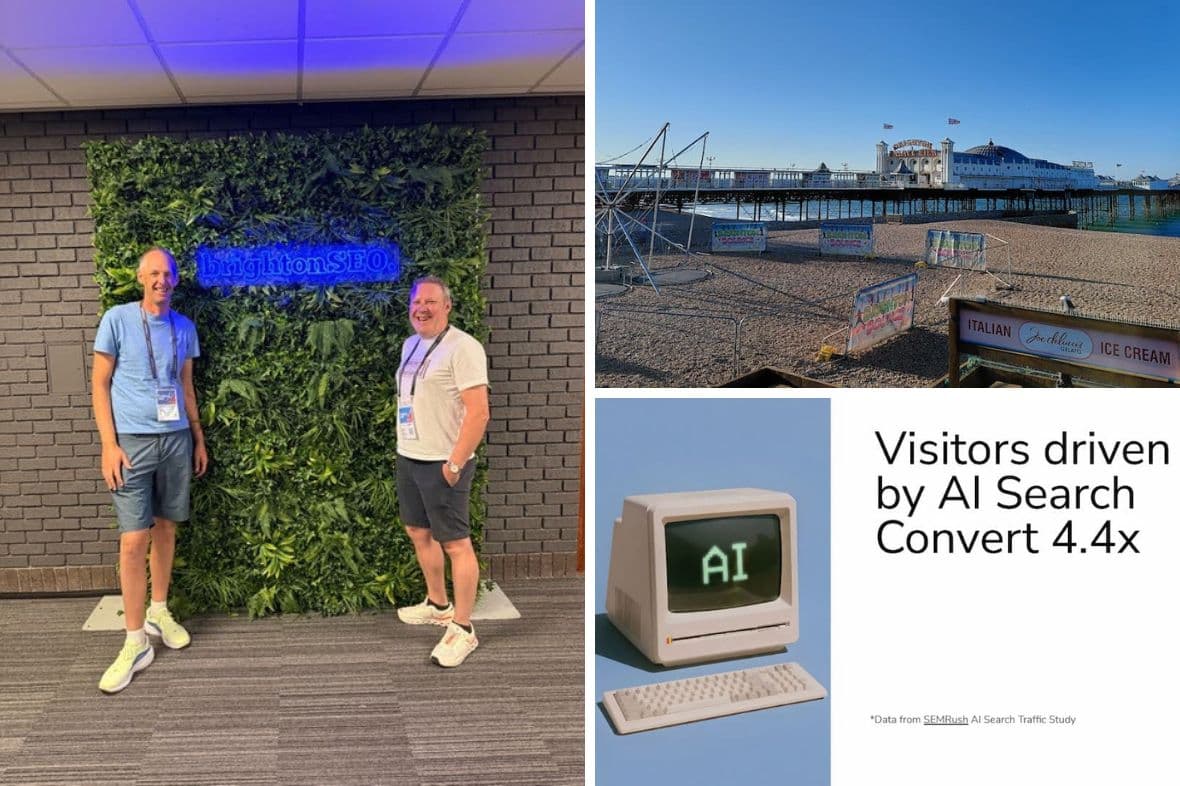
Well, the dust has finally settled and I have got around to writing up the first in a series of posts following a very exciting trip to the UK to the world’s biggest and leading SEO conference, BrightonSEO. This was my first major conference in a couple of years, and I was pretty excited to learn more about how my fellow SEOs are tackling the ever-growing opportunities and challenges our industry faces from AI. The conference did not disappoint.
I was fortunate to attend with our Director, Paul, so we were able to cover a lot of ground, attending different sessions and strands to maximise our learning opportunities. Each session was an hour and 20 minutes long, broken into four 20-minute presentations, so it was pretty intense but a great way to keep the audience engaged and for presenters to really get to the nitty-gritty of what it was they wanted to say.
Some of the talks could have been longer. There were some really engaging speakers who I would have loved to hear more from, and some didn’t quite hit the mark for me – mainly because they were targeted at huge agencies or large corporates with huge budgets beyond what our clients are currently investing. That’s not to say the topics didn’t excite me – I just wish we had bottomless budgets to deliver some of the exciting possibilities that AI presents.
After spending three days in Brighton, I extended my UK trip to catch up with family and since returning to New Zealand, I have been deep in the weeds, working through my notes and implementing the quick-win actions we learnt at the conference but I am happy for some time now to sit back and reflect, as well as sharing our learnings, whilst encouraging brands like yours (hopefully!) to reach out for a conversation about what we have learnt and how it can apply to your business.
The Bigger Picture: What Kind of Conference is BrightonSEO?
Before diving into the themes, it’s worth explaining what BrightonSEO actually is, because it’s unlike most conferences I have attended. It’s held in the Brighton Centre, a proper seaside conference venue on the south coast of England, and it draws thousands of attendees from agencies, in-house teams, and brands from across the world. Think SaaS companies, global retailers, independent agencies, charity sector SEOs, and everyone in between, all crammed into a building that smells faintly of salt air and ambition.
Despite living in England for the best part of 30+ years, this was actually my first ever trip to Brighton and with jetlag snapping at my heels, I made the most of some early morning starts to explore this very cool city. With the sun shining, it wasn’t always easy to head back inside after some of the mid-session breaks, however, the engaging nature of the sessions meant that the days flew by.

The format is relentless but genuinely energising. Four 20-minute talks per session, back to back, across multiple auditoriums simultaneously. Paul and I deliberately split up so we could cover as much ground as possible. He had also attended the Digital PR Summit a week earlier in April, as well as different BrightonSEO sessions to my own, which means between us we have an unusually broad picture of what the industry is thinking about right now.
The dominant topic? You already know the answer. AI. Every single session touched on it. But what was refreshing and reassuring was how grounded most of the conversation was. This wasn’t a conference full of breathless hype. It was a room full of practitioners asking hard questions: what is actually working, what is wasted effort, and what does this mean for the brands we work with?
Another thing that was reassuring for us was to learn that the work we have been focusing on since the turn of the year to improve our clients’ visibility in AI platforms was ticking all the right boxes – we just discovered some extra boxes to tick throughout the conference.
Paul’s take:“I went in with some scepticism. There are so many voices online claiming AI has ‘changed everything’ and selling new products or services off the back of that fear. What I found instead was a really honest conversation about uncertainty and a consistent message that the fundamentals haven’t changed as much as the noise suggests. That was worth the trip on its own.”
Eight Themes That Ran Through Everything
Between the two of us, we attended sessions across three events. What was striking was how consistently the same themes emerged, regardless of the speaker or the strand. Here’s what the industry is collectively thinking about.
Theme 1: Traffic Is No Longer the Right Metric and Most of Us Already Know It
This was said in some form in almost every session I attended. Jack Lingard opened with a genuinely sobering statistic: 93% of AI-driven searches end without a click. Let that sink in. Not 20%. Not 50%. Ninety-three per cent.
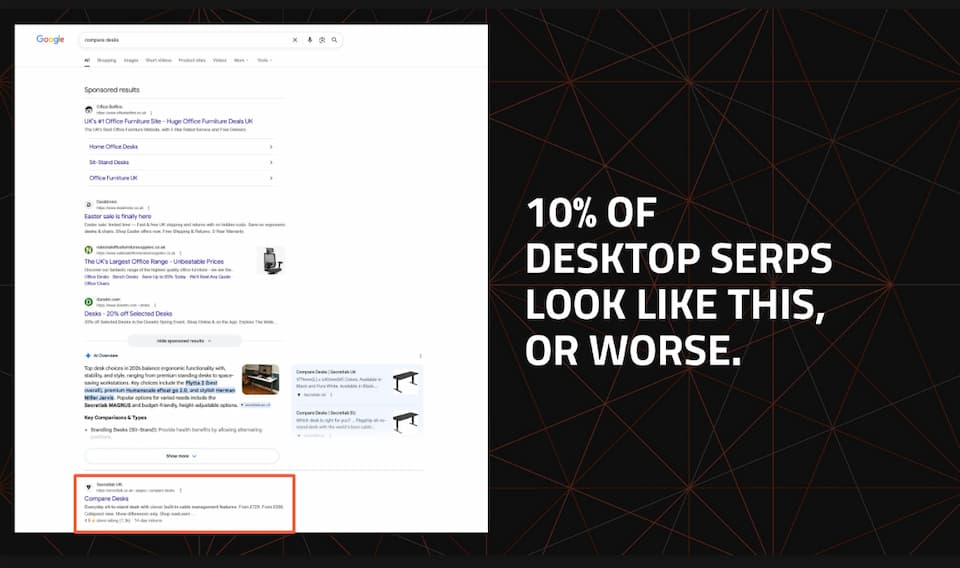
Tom Capper from STAT showed data that position #1 in Google, the holy grail we’ve all chased for years, is now only visible above the fold on desktop approximately 65% of the time. On mobile, it’s often below the fold entirely before you’ve even started scrolling. The search result page has been colonised by ads, AI Overviews, shopping carousels, and rich snippets, pushing traditional organic results further and further down.
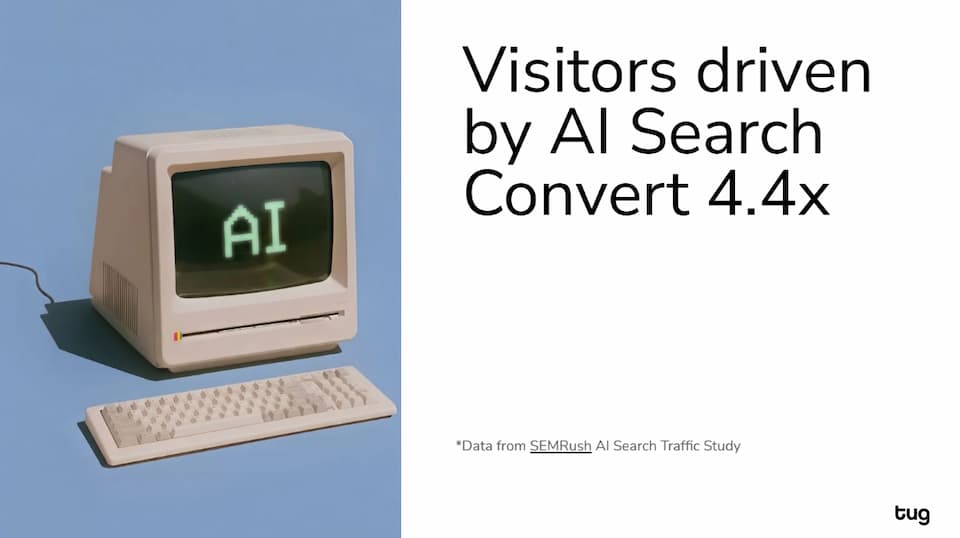
But here’s the twist, and it’s important. Paul’s session with Nick Beck delivered a data point that flipped the narrative entirely: visitors who arrive at your site from AI search convert at 4.4 times the rate of traditional organic visitors. The volume may be smaller, but the intent is sharper, and the conversion rate is dramatically better. This is not a story about decline. It’s a story about quality over quantity.
The consensus from both days was clear: we need to stop using traffic as the primary measure of SEO success and start measuring what actually matters – conversions, revenue, brand visibility, return visits, and the cost of acquiring a customer across every channel.
Paul’s take:“One thing that came through strongly in both roundtables was how much damage traffic-first reporting has done to client relationships. Clients expect traffic to go up every month, and when it doesn’t, even if the business is performing well, it creates anxiety and erodes trust. Moving to business-impact reporting is both the right thing to do and genuinely better for everyone.”
Theme 2: AI Is the New Word of Mouth, and It Has a Long Memory
Jack Lingard put it brilliantly: “AI is word of mouth on steroids.” It doesn’t just look at your website. It pulls in your reviews, your Reddit mentions, articles written about you three years ago, your YouTube presence, what people are saying about you on forums, and it synthesises all of that into an answer.
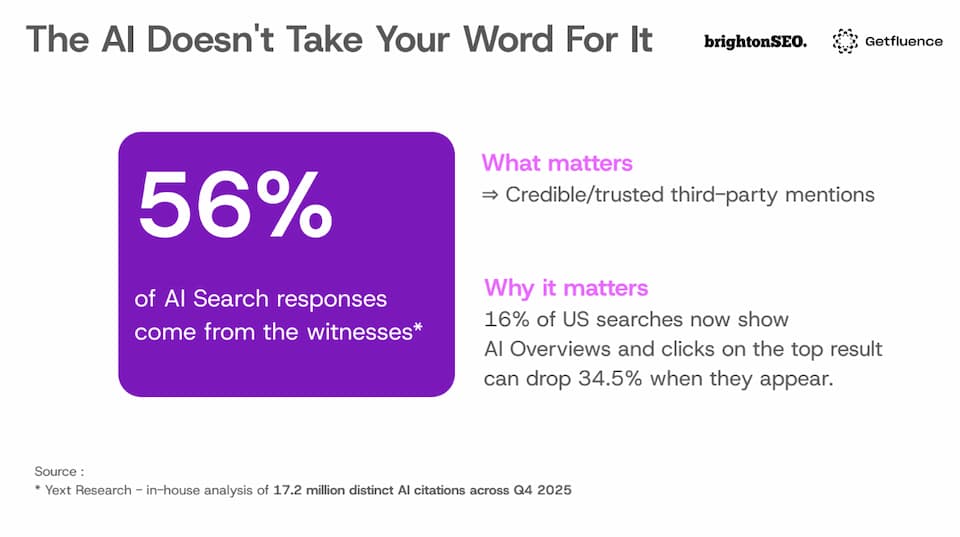
Christian Desert from Getfluence shared research showing that 56% of AI visibility influence comes from external sources, meaning your own website accounts for less than half of what determines whether an AI platform mentions you favourably. This was one of the most cited statistics across both days, and rightly so. It fundamentally reframes where we should be spending our effort.
Sean Barber, the SEO Manager at Macmillan Cancer Support, made a point that I keep coming back to: AI models infer credibility from patterns across the web, not necessarily from truth. They look at consistency – are the same facts, stories, and signals appearing in multiple credible places? – and they reward brands whose narrative is coherent and widespread.
The uncomfortable result of this is that negative sentiment doesn’t disappear. Janaina Barreto-Romero demonstrated that old reviews and negative Reddit threads can still be cited by LLMs today, even years after they were posted. If your brand has baggage anywhere on the internet, AI will find it and serve it up.
Paul’s take:“The Digital PR Summit sessions reinforced this powerfully. Michael Bates from Herd talked about how brands need to actively shape their narrative across every touchpoint because AI is aggregating all of it. It’s not enough to have a great website if the story being told about you across the rest of the web is inconsistent or negative.”
Theme 3: Original Data Is the Most Powerful Thing You Can Create
This came through strongly in Paul’s Digital PR Summit notes, and it’s something I think is deeply relevant to every business we work with, regardless of size.
Madeleine Lambert made the case plainly: traditional PR is saturated. Journalists are overwhelmed with content. AI has created a content explosion. The only truly irreplaceable asset is exclusive data – information that nobody else has, that tells a story no one has measured yet.
George Sinnott’s framework from the Digital PR Summit is one I’ll be returning to repeatedly: start with a question that people suspect the answer to, but that nobody has actually measured. Then find the data that answers it. The stories that land with journalists today are relatable, visual, quantified, surprising, and tied to real consumer impact. If you can’t make it a chart or a screenshot, it probably won’t fly.
Sacha Fournier went even further. He demonstrated how you can build a data campaign in under 30 minutes using publicly available app data, no developer required. The bar for data-driven PR is lower than most businesses think.
This matters for AI too. Original research and data-rich content are precisely the kind of source material that LLMs cite. Being the originator of a statistic or dataset that gets picked up across media and industry platforms is one of the most reliable ways to earn AI citations.
Theme 4: The Technical Foundations Haven’t Changed, But They Matter More Than Ever
If there was a message that should reassure every business owner worried about having to reinvent their entire digital strategy, it was this one: the fundamentals are the same.
What does an LLM need to be able to find and trust your content? A technically clean website that can be crawled and rendered. Structured data that makes it easy to understand what you are and what you offer. Clear, authoritative content written by people with genuine expertise. Consistent signals across all platforms. Strong external references from trusted sources.
Sound familiar? It should. It’s E-E-A-T. It’s what Google has been asking for years. The difference is that now it’s not just Google doing the asking.
One genuinely alarming finding that Janaina and Judith Lewis both highlighted: if your website uses heavy JavaScript rendering, particularly client-side rendering, AI crawlers may simply not be able to read your content. It’s essentially invisible to them. As Judith put it, it’s like being back in 2012 when Google couldn’t handle anything other than plain HTML. This is fixable, but only if you know it’s a problem.
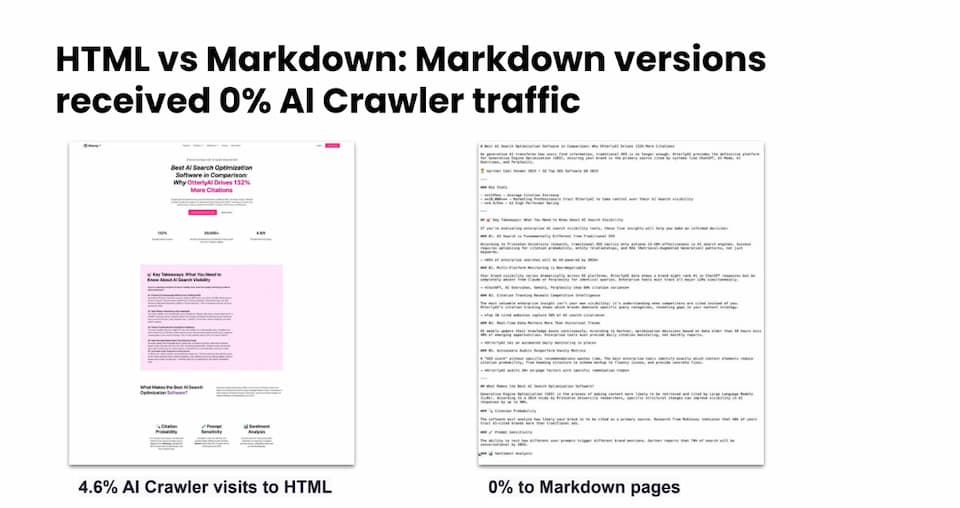
Thomas Peham from Ryte did something brave. He published his own experiment results, including things that didn’t work. LLMs.txt files? Not working. 0.1% of AI bot traffic accesses them, with no positive correlation to visibility. Markdown versus HTML? HTML wins clearly. Schema markup? Significant impact on Google visibility, but limited measurable impact on other LLMs right now, though still worth implementing as the landscape evolves. His message: test everything and share the results, because the industry needs honest data, not snake oil.
Paul’s take:“The session on entity architecture from Darko Brzica was one I keep coming back to. The concept of Schema SameAs mapping – connecting your brand entity signals across Wikipedia, LinkedIn, Google Business Profile, Wikidata, and industry directories – is something we should be doing for every client. It’s not glamorous work, but it’s foundational.”
Theme 5: Your Brand Entity Matters More Than Your Domain Authority
This theme was woven through multiple sessions and represents one of the more significant strategic shifts in how we should think about building online presence.
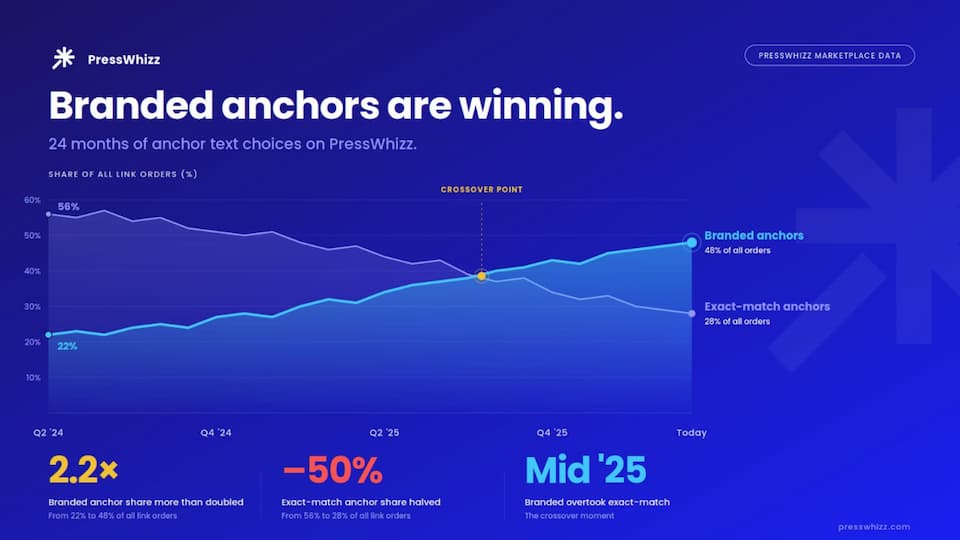
Darko Brzica’s session on link building and AI signals was packed with data. One finding stood out: branded anchor text is now outperforming exact-match keywords in terms of link effectiveness. A 2.2% branded anchor share is beating the traditional exact-match approach. The web is moving toward recognising brand entities, not just keyword signals.
The Knowledge Graph, the underlying structure that connects entities in Google and increasingly in AI platforms, uses something like a confidence score for your brand. The more consistent, the more widely referenced, and the more interconnected your brand information is across credible platforms, the higher that confidence score climbs. Wikipedia, LinkedIn, your Google Business Profile, Trustpilot, Capterra, relevant industry directories – these are not afterthoughts. They are infrastructure.
Paul’s Digital PR Summit sessions reinforced this from the PR angle: brands that have a distinctive, consistent narrative across all the places where AI learns from are the ones earning citations. Brands that are generic, inconsistent, or simply absent outside their own website are invisible.
Theme 6: Content Must Be Demand-Led and Audience-First
Sophie Coley delivered what was, for me, one of the most practically useful sessions of the entire conference. Her core message: stop chasing search volume and start chasing audience understanding.
She introduced the concept of audience facets – granular, specific elements of your customer’s situation, triggers, language, and context. Not just “people who buy running shoes” but “a nurse working 12-hour shifts who needs shoes that work equally well in the gym and on a ward.” The more precisely you understand who you are writing for and why they need what you offer, the more likely your content is to appear in AI answers, because AI systems are trying to answer precisely that kind of contextual, specific question.
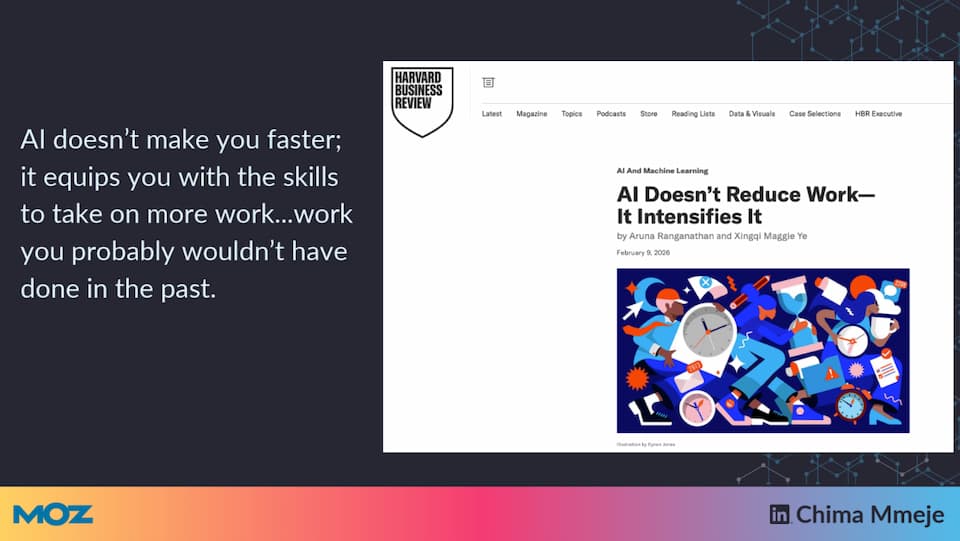
Chima Mmeje backed this up with her demand-led content framework. The sources she use to find real demand? LinkedIn conversations. Customer feedback. Reddit. Events and conferences. These are places where people express genuine needs in their own language, which is exactly the kind of language that appears in AI prompts.
Daniel Liddle put it most starkly: “AI aggregates the average. In an emerging channel, average is invisible.” If your content looks like everything else, because it was produced at scale using AI to follow the same templates as your competitors, you will not be cited. The opportunity is still firmly in the ideas, the originality, and the expertise. No tool can replicate what you genuinely know.
Paul’s take:“Daniel Cartland’s session backed this up with real numbers. He showed a client whose blog was driving 50% of their sessions but only 7% of their revenue. The content was generating traffic but not connecting to commercial intent. That’s a problem a lot of brands have, and it reinforces Sophie’s point – traffic from the right audience beats volume every time.”
Theme 7: Measurement and Reporting Need a Complete Overhaul
This is the one that keeps me up at night, in the best way. Our industry has spent 20 years building reporting frameworks around metrics that are now either declining, unreliable, or both. GA4’s cookie rejection rate is running at approximately 60%, meaning a substantial portion of actual user behaviour is simply unrecorded. AI is abstracting the user journey, turning what used to be a click into an invisible interaction.
James Yorke proposed the Presence/Preference/Performance model as a replacement framework for SEO reporting: Presence – are we visible where our audience is looking (rankings, AI answers, SERP features)? Preference – are they choosing us (brand search volume, direct traffic, return visits, assisted conversions)? Performance – are we converting that attention into revenue (clicks, sessions, leads, sales)?
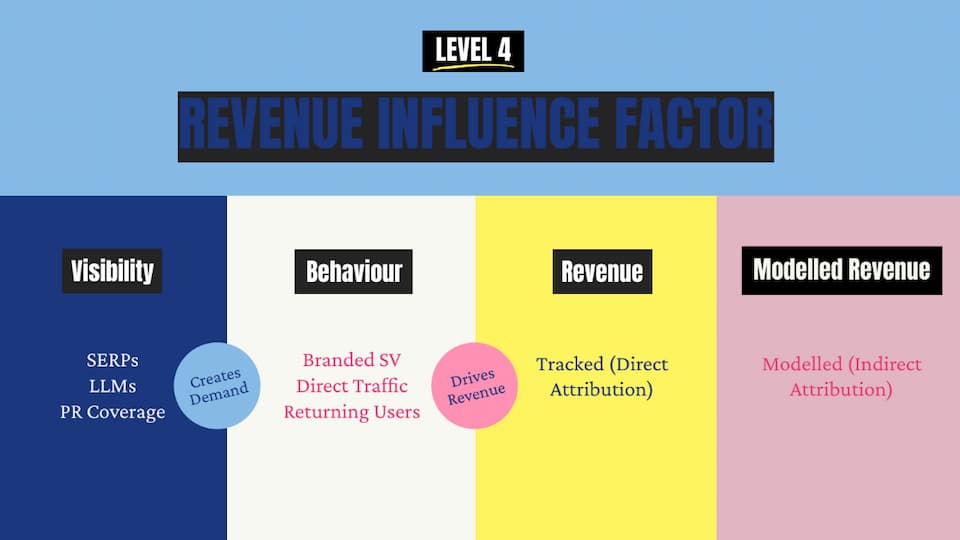
Jack Lingard’s Revenue Influence Factor is another framework worth exploring. It’s a way of attributing indirect revenue impact to organic work using causal and regression analysis, moving beyond last-click attribution to model the business value of visibility that doesn’t result in an immediate click.
Judith Lewis made the point that landed most clearly with me: “Report on money. C-suite executives prioritise financial metrics above all else.” If we walk into a client conversation talking about impressions and keyword rankings, we are speaking a language that doesn’t connect to what matters to them. If we walk in talking about revenue influence, cost per acquisition, and conversion rates by channel, we are finally speaking the same language.
Theme 8: AI Must Be Embedded in Workflows, Not Bolted On
Both Paul’s invite-only agency roundtable on Day 1 with agency owners and my invite-only roundtable on Day 2 with heads of agencies, covered this territory in depth, and the message was consistent.
The benchmark that was cited in my roundtable: 1 human hour should equal 10 hours of AI output. That’s the efficiency standard the leading agencies are building towards. Not as a way to cut costs, but as a way to free up human capacity for the work that actually requires human judgement – strategy, relationships, creative direction, and the genuinely difficult questions.
The agencies that are struggling with AI are the ones that have added AI tools to existing processes without rethinking those processes. The agencies that are winning have done the harder work of mapping their workflows from scratch and asking where AI genuinely improves the output, not just the speed.
Tom Winter’s principle from his session on AI content production stuck with us both: “A process that cannot be measured cannot be fixed. A process that cannot be fixed cannot scale.” That applies to AI integration just as much as it does to content production.
Paul’s take:“Amanda Walls’ session at the Digital PR Summit was a practical masterclass in this. She’s built a suite of Custom GPTs that automate compliance screening, newsjacking, coverage scanning, journalist profiling, and link gap analysis, each one handling a workflow that used to require significant manual time. The question isn’t whether to use AI. It’s whether you’re being systematic about it.”
What This Means for Your Business
If you’ve read this far, you might be wondering what all of this means in practical terms for a business like yours. Not a global enterprise with a dedicated SEO team and unlimited budget, but an SME or mid-market brand trying to grow sustainably in a changing landscape.
Here’s the honest answer: the shift is real, but it’s not as scary as some of the headlines suggest. The brands that will struggle are the ones producing generic, undifferentiated content and measuring success purely by traffic. The brands that will thrive are the ones that know their audience deeply, communicate consistently across multiple channels, build genuine credibility through authentic content and external references, and measure what actually drives revenue.
That’s not a new game. It’s the same game, played on a bigger board.
Five things worth doing right now:
- Run the AI mirror test. Open ChatGPT, Claude, Gemini, and Perplexity. Search for your product or service category. See what comes up. See what it says about you. See what it says about your competitors. This takes 20 minutes and will tell you more than a month of rank tracking.
- Audit your brand presence beyond your website. Check your Google Business Profile, your Trustpilot and Google reviews, your social profiles, any Wikipedia or Wikidata entries. Is the story consistent? Is it accurate? Is it present at all?
- Take your reviews seriously. Not just as customer service but as an AI signal. LLMs actively cite reviews, including old ones. Building a structured, consistent process for generating and responding to reviews is now a genuine search strategy.
- Have an honest conversation about your reporting. If your monthly report leads with traffic and keyword rankings, it’s time to evolve. What revenue can you attribute to your digital marketing? What is the cost of acquiring a customer through organic channels? These are the questions that matter.
- Get in touch with us. We have come back from Brighton with a clear view of what the next 12 months should look like for the brands we work with, and we are very happy to share that thinking with you.
Coming Up in This Series
This hub post is the first in a seven-part series exploring each of the major themes from BrightonSEO in much more depth. Over the coming weeks, we will be publishing:
- Why Your Website Traffic Is Falling And Why That Might Be Fine – a deep dive into the zero-click reality and what to measure instead
- How to Get Your Brand Mentioned by ChatGPT, Claude and Google’s AI – a practical guide to building AI visibility across every channel that matters
- The End of Content for Content’s Sake: How to Build an Audience-First Content Strategy – applying the demand-led content frameworks from Sophie Coley, Chima Mmeje, and others to real businesses
- Technical SEO in the Age of AI: The Non-Negotiables Your Website Cannot Afford to Ignore – from JavaScript rendering to schema markup to log file analysis
- Why Being Talked About Online Has Never Mattered More – brand authority, digital PR, and the new rules of third-party credibility
- How to Prove the Value of SEO in a World Where Clicks Are Declining – rebuilding your measurement framework around what actually moves the needle
Each post will include practical actions you can take regardless of the size of your business or your budget. And as always, if any of this prompts a question or a conversation, we would love to hear from you.