

Introduction: The Best Marketing Is What Other People Say About You
Think about the last time you chose a new accountant, builder or software supplier. You probably looked at their website. But what likely tipped the decision was what someone else said: a review, a recommendation from a friend, a mention in a local news story, an industry award, or a list of the best options in your area.
That’s the whole idea behind digital PR. It’s the work of getting credible websites, publications and people to talk about your business, so that when a customer, Google or an AI tool such as ChatGPT goes looking, they find more than just your own claims about yourself.
It’s also one of the most misunderstood services in marketing. Some agencies sell it as press releases. Others use the term to dress up buying links. Neither is what we mean, and neither is what works.
This guide is the plain-English starting point. It’s the first supporting guide in our Digital PR series, building on The Modern Digital PR Playbook and our BrightonSEO 2026 recap, Why Being Talked About Online Has Never Mattered More. We’ll cover:
- What digital PR is, in plain English
- How it differs from traditional PR and from link building
- Why it matters for your search rankings, your visibility in AI tools and your reputation
- What digital PR actually looks like day to day
- How to tell whether it’s working
- Whether it’s right for your business, and how to make a start
What Is Digital PR?
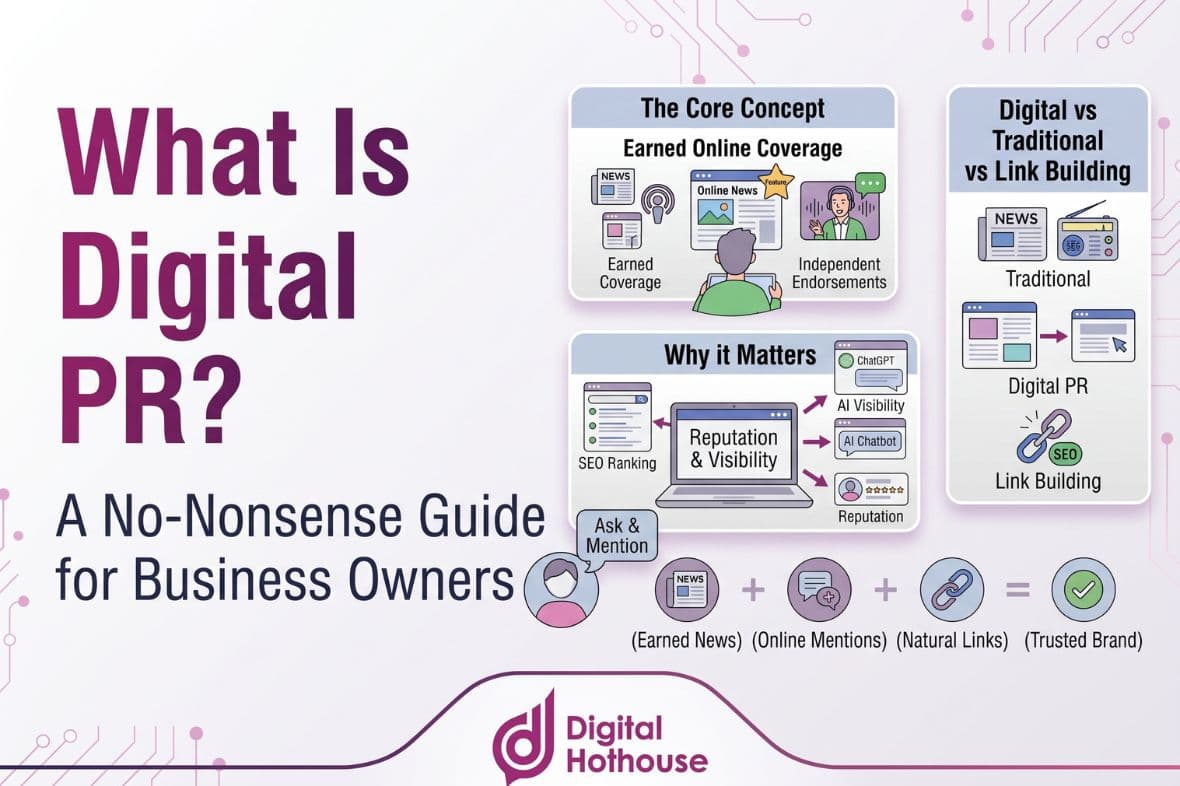
Digital PR is the practice of earning coverage, mentions and links for your business on credible websites you don’t own: online news sites, trade publications, industry blogs, podcasts, community sites and the like. You earn that coverage by giving journalists, editors and creators something genuinely worth sharing with their audience, such as expert comment, useful data, a strong local story or a product worth writing about.
The key word is earned. Nobody is paid to run the story, and the publication decides whether you’re worth including. That’s exactly why it carries weight with readers, with search engines and, increasingly, with AI tools.
It helps to start with what PR has always been about. The Chartered Institute of Public Relations, the UK’s professional body for PR, defines public relations as being about reputation, which it describes as the result of what you do, what you say and what others say about you. Digital PR focuses on that last part, in the places it now happens most: online, where it can be found, searched, linked to and read by machines as well as people.
In practice, a successful piece of digital PR usually leaves behind three things:
- Coverage that real people in your market read, watch or listen to
- Brand mentions on credible sites, whether or not they link to you
- Links from relevant, trusted websites back to yours
All three matter, and a good digital PR programme aims for all three, rather than treating any one of them as the whole point.
Digital PR vs Traditional PR vs Link Building
You’ll often hear these three used interchangeably. They overlap, but they aren’t the same thing, and knowing the difference is the quickest way to spot whether someone is selling you the real thing. There are no official definitions, so treat the comparison below as how the terms are generally used in our industry rather than a hard rule:
| Traditional PR | Digital PR | Link building | |
| Main goal | Reputation and awareness | Reputation, awareness, search visibility and AI visibility | Search rankings |
| Where it appears | Print, TV, radio and their websites | Online news, trade and niche sites, blogs, podcasts, review and community platforms | Any website that will link to you |
| How it’s earned | Press releases, media relationships, events | Newsworthy stories, expert comment, data, journalist relationships | Ranges from genuine outreach to paid placements |
| What it leaves behind | Coverage and goodwill | Coverage, brand mentions and links | Links |
| How it’s usually measured | Reach, sentiment, share of voice | All of those, plus referring domains, branded search and AI mentions | Number and authority of links |
| The main risk | Hard to connect to sales | Takes time and a genuine story | Paid links can breach Google’s policies |
Digital PR and traditional PR
They share the same instincts: find a story, understand what a journalist needs, build relationships and protect your reputation. The difference is where the result lands and how long it lasts. A radio interview is gone once it airs. An article on a respected news site can be read, searched, linked to and referenced by AI tools for years.
Digital PR and link building
This is where the confusion usually lies. Link building simply means getting other websites to link to yours, and done well, it overlaps heavily with digital PR: genuine outreach to relevant sites, with something worth linking to, is good practice.
The problem is the other end of the market. Google’s spam policies list buying or selling links for ranking purposes as link spam, including paying for posts that contain links and sending someone a product in exchange for a write-up with a link. Paid links are fine only when they’re clearly marked as sponsored, which tells Google they shouldn’t count as an endorsement. So if a provider promises a set number of “high-authority links” for a fixed monthly fee, it’s worth asking exactly how those links are being earned.
The simplest way to put it: good digital PR almost always produces links, but chasing links on their own rarely produces good PR.
Why Digital PR Matters for Business Owners
Digital PR used to be filed under “nice to have” for most small and medium businesses. Three changes have moved it much closer to essential.
Google pays attention to what others say about you
Links from relevant, trusted websites remain one of the ways search engines judge which pages deserve to rank, which is exactly why Google works so hard to stop people faking them. But it goes beyond links. Google’s Search Quality Rater Guidelines, the handbook its human reviewers use to assess search results, ask raters to research a website’s reputation using independent sources, and to trust those sources over what a business says about itself when the two disagree. Raters don’t set rankings directly, but the guidelines are a clear signal of what Google’s systems are designed to reward.
AI tools build their answers from what others say about you
When someone asks ChatGPT, Google’s AI Mode or Perplexity to recommend a business, the answer is put together from sources across the web. Google is explicit about this in its guidance on optimising for generative AI features, noting that its AI features can show what’s being said about products and services in blogs, videos and forum discussions. In the same guidance, it warns that chasing inauthentic mentions isn’t as helpful as it might seem. The mentions that count are the ones you’ve genuinely earned.
The research points the same way. Ahrefs’ study of 75,000 brands found that branded web mentions had the strongest correlation with appearing in Google’s AI Overviews (0.664), far stronger than the number of backlinks (0.218). Ahrefs is clear that correlation isn’t causation, and these are its own figures, but the direction is hard to ignore: brands that are talked about across the web tend to be the brands AI tools talk about. We cover how that works in more detail in our beginner’s guide to Generative Engine Optimisation (GEO).
Your customers check you out before they call
In our experience, very few customers make a significant purchase based on a business’s own website alone. They search the business name, read reviews, look for coverage and ask around. A credible article, an expert quote in a trade publication or a mention in a local “best of” list does the same job a personal recommendation used to do, and it keeps doing it every time someone searches your name.
Earned coverage keeps working
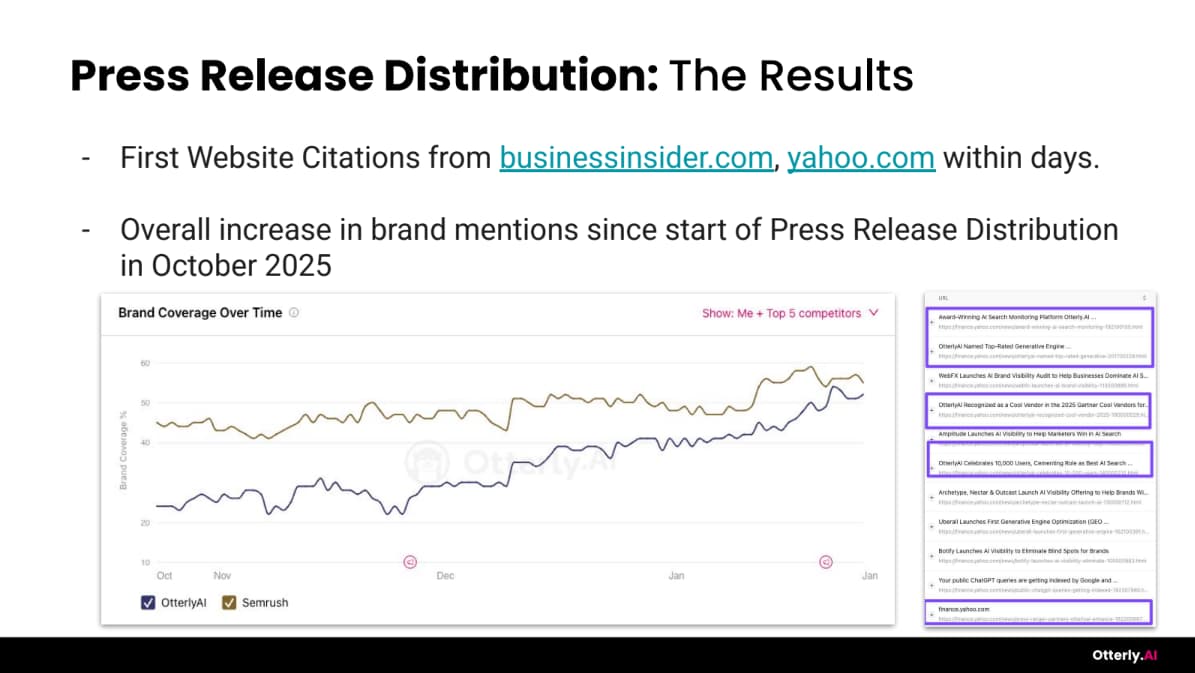
An advert stops the day you stop paying for it. A good article on a well-read website can keep sending visitors, supporting your rankings and feeding AI answers for years. That compounding effect is why we treat digital PR as an investment in a business’s reputation, rather than a one-off campaign cost.
What Digital PR Looks Like in Practice
Digital PR isn’t one tactic. It’s a toolkit, and most businesses will only ever need a few of the tools in it. These are the ones we see working most often for small and medium businesses:
- Expert commentary. Journalists constantly need credible people to explain, react to or add context to a story. Responding to journalist requests through free services such as HARO and Source of Sources, or simply becoming the go-to person a local reporter calls about your industry, is often the most realistic starting point.
- Data-led stories. Your business may be sitting on data a journalist would find genuinely interesting: seasonal trends in enquiries, the most common problems you fix, how prices have changed in your region. Turned into a clear finding, that becomes a story nobody else can tell.
- Reacting to the news. Sometimes called newsjacking, this means offering a timely, relevant point of view when something in the news touches your industry, such as a law change, a weather event or a new report.
- Local and community stories. In a market the size of New Zealand, local news sites, regional papers and community publications are often more valuable than a national masthead. A new service, a milestone, a local partnership or a community initiative can all be genuine local news.
- Product coverage. For retailers and ecommerce brands, getting products into editorial gift guides, reviews and “best of” roundups puts them in exactly the kind of content people, and AI tools, consult before buying.
- Industry recognition. Awards, association memberships, speaking slots and guest appearances on podcasts all create credible, independent mentions of your business and the people behind it.
Relevance beats volume, every time
Whatever the tactic, the single biggest factor in whether it works is relevance. Muck Rack’s State of Journalism 2026 survey of almost 900 journalists found that 86% say at least some of their stories start with a PR pitch. But 88% immediately disregard pitches that miss their beat, and 78% say a pitch feels genuinely relevant when it directly affects the community their audience belongs to. The respondents were mostly US-based, so the exact figures may differ here, but in our experience the principle holds just as strongly with New Zealand media.
In practice, that means a handful of carefully chosen, well-researched pitches to the right people will almost always outperform a press release sent to hundreds of inboxes.

Real people, real expertise
The other ingredient that makes digital PR work is genuine expertise from real people in your business. Journalists, and increasingly AI tools, are getting better at spotting generic or manufactured commentary.
Paul’s take: “James Roach at the Digital PR Summit made a point about authenticity in expert sourcing that connects to this. He said AI and journalists alike now detect generic, fabricated personas and expert commentary. The brands that earn coverage and citations are the ones where real people with genuine expertise are speaking publicly, whether through interviews, guest commentary, social posts, or video. That’s a prompt for us to think about how we help clients build genuine expert profiles, not just review scores.”
What BrightonSEO 2026 Told Us About Digital PR
When Paul and I attended BrightonSEO earlier this year, digital PR came up again and again, and Paul also attended the Digital PR Summit the week before, and we covered it in depth in Why Being Talked About Online Has Never Mattered More. Three findings are especially useful if you’re new to the subject:
- Digital PR is now part of SEO. James Roach argued at the Digital PR Summit that digital PR isn’t a separate channel from SEO at all. It’s SEO carried out beyond your own website.
- Most of your AI visibility is shaped elsewhere. At BrightonSEO, Christian Desert of Getfluence shared that 56% of AI visibility influence comes from external sources, meaning your own website accounts for less than half of the picture.
- Small and targeted beats big and broad. Vince Nero of BuzzStream shared research showing that small, highly personalised outreach campaigns of 25 to 50 emails earned 17 times more links than mass email blasts.
One Digital PR Summit session stayed with Paul in particular. Michael Bates of Herd argued that, as AI pulls together everything written about a business, your brand story is increasingly the sum of what everyone else says about you, not just what you say about yourself.
Paul’s take: “Michael’s session was one of the few that actually made me feel slightly uncomfortable about our own work, because I could think of clients immediately where this exercise would reveal real inconsistencies. The good news is that the audit itself is something we can run relatively quickly, and the findings give us a clear, prioritised action list. It’s one of the things we’re building into our onboarding process for new clients.”
The common thread is that what other people say about your business now shapes how you’re found, in search results and in AI answers alike. That makes your brand’s story across the web something worth checking, not assuming.
How to Tell If Digital PR Is Working
One of the fairest criticisms of PR over the years is that it’s hard to measure. Digital PR is easier, because almost everything it produces leaves a trail you can track. These are the measures we’d suggest a business owner keeps an eye on:
| What to measure | What it tells you | Where to find it |
| Coverage | Where you were featured, and whether those outlets reach your customers | A simple coverage log, plus Google Alerts on your business name |
| Referring domains | How many relevant websites now link to yours | Search Console’s Links report, or tools such as Ahrefs or Semrush |
| Brand mentions | How often you’re mentioned, with or without a link | Google Alerts or a media monitoring tool |
| Referral traffic and enquiries | Whether the coverage is sending people who go on to get in touch or buy | Your analytics, filtered by referring website |
| Branded search | Whether more people are searching for your business by name | The Performance report in Google Search Console |
| AI visibility | Whether AI tools mention you, and what they say | Asking ChatGPT, Gemini, Perplexity and Google’s AI Mode the questions your customers ask |
Two cautions are worth knowing before you start.
Be wary of “advertising value” figures. Some reports put a dollar value on coverage by calculating what the same space would have cost as an advert. AMEC, the international body for communications measurement, states plainly in its Barcelona Principles 3.0 that advertising value equivalents are not the value of communication. Look for evidence of real outcomes instead: enquiries, sales, rankings and reputation.
Give it time. Digital PR builds over months, not weeks. A single piece of coverage can deliver a quick spike in traffic, but the bigger benefits for search and AI visibility come from a steady build-up of credible mentions. We’d normally expect to judge a programme over six to twelve months, not after the first campaign. We go deeper on reporting in How to Measure and Prove SEO ROI When Clicks Are Declining.
Is Digital PR Right for Your Business?
For most businesses, the honest answer is yes, but the scale and timing matter. Digital PR tends to work best when:
- You have genuine expertise that people in your business can speak about with confidence
- You hold data, insight or experience that others in your market don’t
- Your customers research before they buy, rather than choosing on price alone
- You’re competing with businesses that are already being mentioned, recommended or cited where you aren’t
It’s worth getting a few foundations in place first, though. If your website is slow or hard to use, your Google Business Profile is out of date or your reviews are thin, those are usually quicker wins, and they’ll make any coverage you earn work harder.
Five first steps
You don’t need an agency or a big budget to start. These are the same first steps we take with most new clients:
- Search for yourself. Google your business name and ask a couple of AI tools what they know about you. Note what comes up, what’s missing and what’s wrong.
- List the publications your customers actually read. Think local news sites, trade publications, industry newsletters, association websites and podcasts. A short list of ten relevant outlets is far more useful than a long list of big names.
- Find your stories. Look for what makes your business genuinely interesting: your data, your expertise, your local involvement, your customers’ results. If you’ve already built a customer persona, the questions your customers ask are often the best starting point.
- Put a real expert forward. Decide who in the business can comment on your industry, make sure they have an up-to-date profile on your website and LinkedIn, and sign them up to receive journalist requests.
- Start small and stay consistent. One useful comment or story a month, sent to the right people, will do more over a year than a single big launch.
Paul’s take: “Most business owners we speak to assume digital PR means chasing the front page. It almost never does. The coverage that makes the biggest difference for our clients is usually a trade publication their customers trust, a local news site, or an industry association that names them as the people to talk to. Start where your customers already are, and be genuinely useful to the people writing for them.”
Four Digital PR Myths Worth Ignoring
These are the misconceptions we hear most often from business owners, and why they shouldn’t put you off.
“Digital PR is just sending out press releases.” A press release is one tool, and on its own, rarely the most effective one. Journalists respond to stories that matter to their audience, which is why a few well-targeted pitches usually beat a release sent to everyone. It’s also worth knowing that Google’s spam policies specifically list links with optimised anchor text in press releases distributed on other sites as an example of link spam, so a release written mainly to build links can do more harm than good.
“It’s just a fancy name for buying links.” It shouldn’t be. Genuine digital PR is earned, not bought. If a provider can promise you a fixed number of links from named websites every month, those links are very likely being paid for, which breaches Google’s policies unless they’re clearly labelled as sponsored.
“It’s only for big brands with big budgets.” If anything, smaller businesses often have the edge. Local and trade media need credible, accessible experts, and an owner who can comment clearly and quickly on their industry is exactly what many journalists are looking for.
“A good agency can guarantee coverage.” Nobody can. Journalists and editors decide what they publish, and that independence is precisely what makes coverage valuable. What a good partner can do is improve your odds with better stories, better targeting and better relationships, and be honest with you about what’s realistic.
Where to Go Next in This Series
This post is the starting point for our Digital PR theme. When you’re ready to go further, The Modern Digital PR Playbook is the full guide, covering campaign planning, newsjacking, journalist outreach, reputation management and a measurement framework. If AI search is your main concern, The Complete Guide to Generative Engine Optimisation (GEO) is the place to start.
Over the coming months, we’ll be publishing more practical guides in the Digital PR series, including:
- How to Build a Digital PR Campaign From Scratch (Step-by-Step)
- Newsjacking 101: How to Get Media Coverage by Reacting to Trends
- HARO and Journalist Outreach Alternatives in 2027
- How Digital PR Builds the Backlinks and Brand Mentions AI Models Trust
- Building Relationships with NZ Journalists and Publications: A Practical Guide
- Data-Driven PR: How to Turn Your Business Data Into Media Stories
- Influencer Partnerships vs Digital PR: What’s the Difference and Do You Need Both?
- Reputation Management: What To Do When Your Brand Gets Bad Press or Reviews
Follow us on LinkedIn so you never miss a post.
Find Out Who’s Talking About Your Business
Digital PR isn’t a dark art or a shortcut. At its heart, it’s the modern version of something every good business already knows: the most persuasive thing anyone can hear about you is what someone else says. The difference now is that search engines and AI tools are listening too, and they’re shaping which businesses your customers find first.
Book a Digital PR Discovery Call with Digital Hothouse. We’ll look at where your business is currently being mentioned, and where it isn’t, check what AI tools are saying about you, and help you find the stories and outlets that are realistic for your budget and genuinely relevant to your customers.
We’d love to work with you. Let’s chat.