

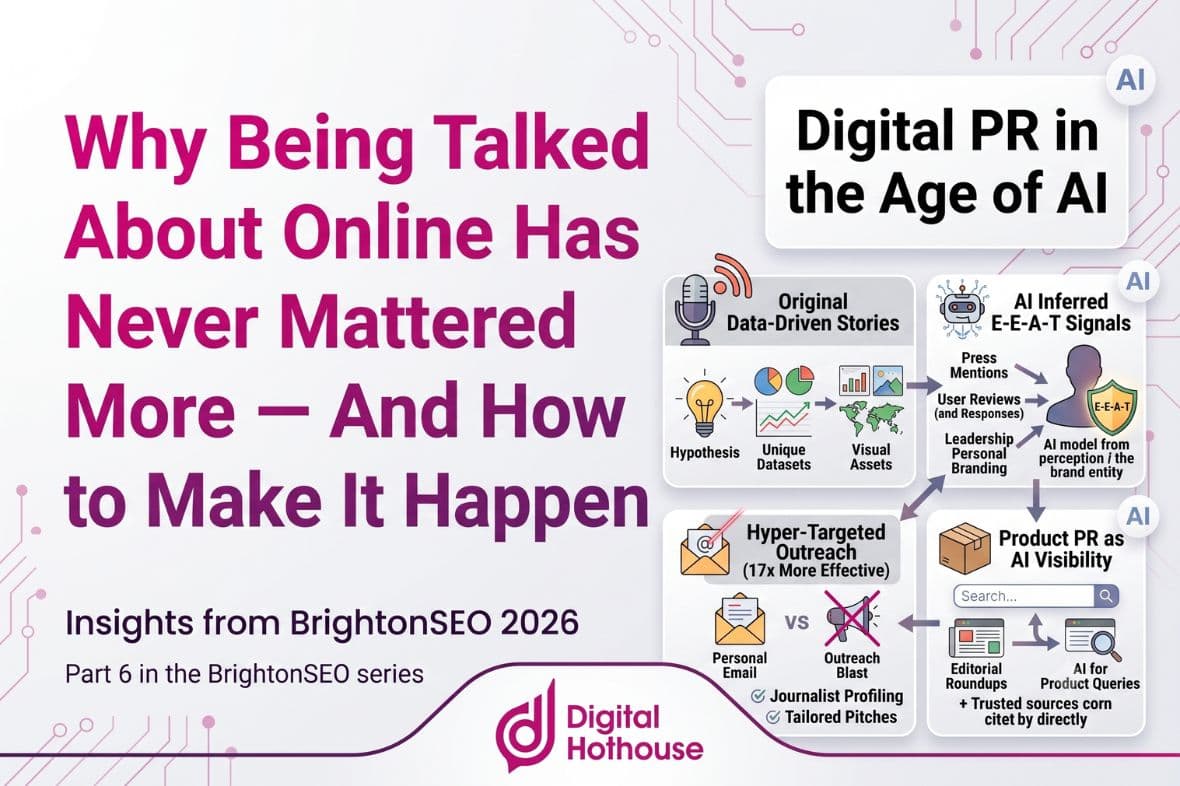
Part 6 in our BrightonSEO 2026 series. Catch up with the hub post, Part 2 on why your traffic is falling, Part 3 on getting your brand mentioned by AI, Part 4 on audience-first content strategy, and Part 5 on technical SEO before reading this one.
The next post in our series based on the key topics and themes from BrightonSEO is an area where we, like many SEO agencies, could do more – Digital PR. Time and budget are the things that hold us back from really pushing on in this space; however, we have returned from Brighton with a new outlook and new ideas when it comes to generating genuine high-interest pieces that relate to our clients and their products and services.
The importance of strong digital PR was outlined by countless speakers across the two days, closely tied to sessions around E-E-A-T, and these were sessions that piqued our interest and got us thinking about the things we can be doing for our clients that can make all the difference when it comes to brand building and visibility across all search platforms.
What made this particularly rich territory was that Paul attended the Digital PR Summit – held a week before BrightonSEO – which meant that between us we had a rare combination of the pure SEO perspective on brand authority and the PR practitioners’ perspective on the same challenge. The convergence between those two worlds was one of the most striking things about the whole trip. The SEOs were talking about E-E-A-T and entity signals. The PR professionals were talking about earned media and brand narrative. They were describing the same thing from different directions.
Let me take you through what we learnt, and more importantly, what it means for your business.
What E-E-A-T Actually Means in 2026
If you’ve been working with Digital Hothouse for any length of time, you’ve heard us talk about E-E-A-T. But given how much the concept has evolved, and how central it is to everything in this post, it’s worth revisiting it properly.
E-E-A-T stands for Experience, Expertise, Authoritativeness, and Trustworthiness. It’s the framework Google uses to evaluate the quality and credibility of content and the entities behind it. The second E – Experience – was added in late 2022, and its addition was significant: it differentiated content produced by people who have genuinely done something from content produced by people who have merely read about it.
In a traditional SEO context, E-E-A-T signals were primarily on-site: author credentials on blog posts, About pages describing the team’s qualifications, case studies demonstrating real-world results. These things still matter. But the BrightonSEO sessions made clear that in 2026, E-E-A-T has become a whole-web discipline.
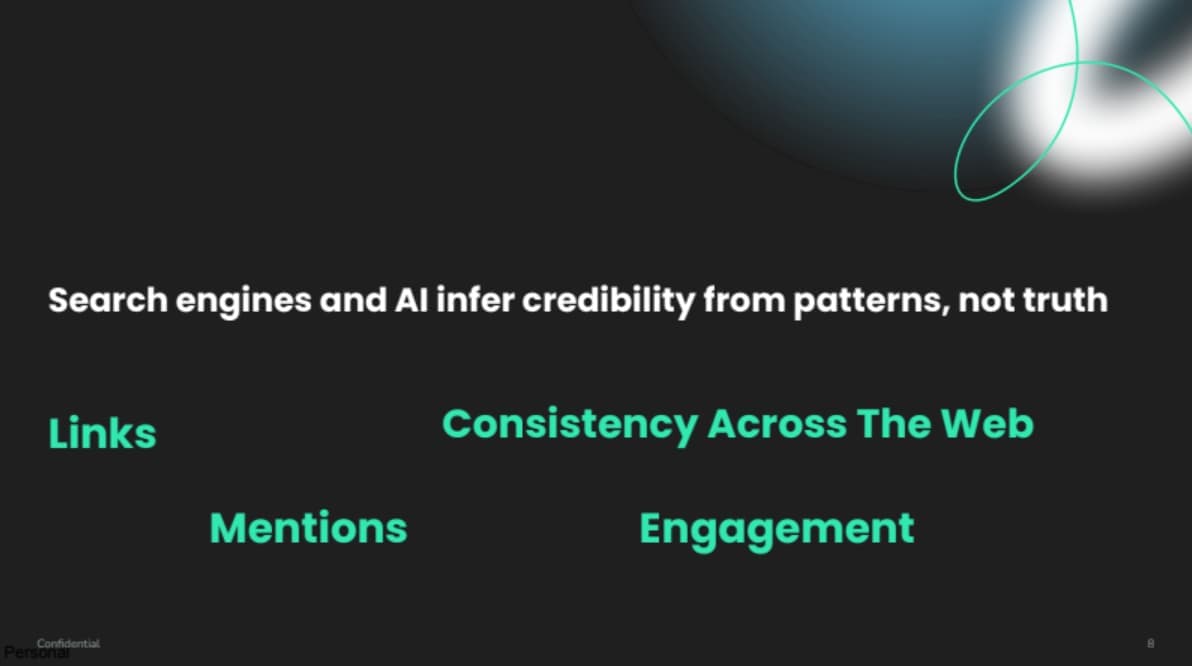
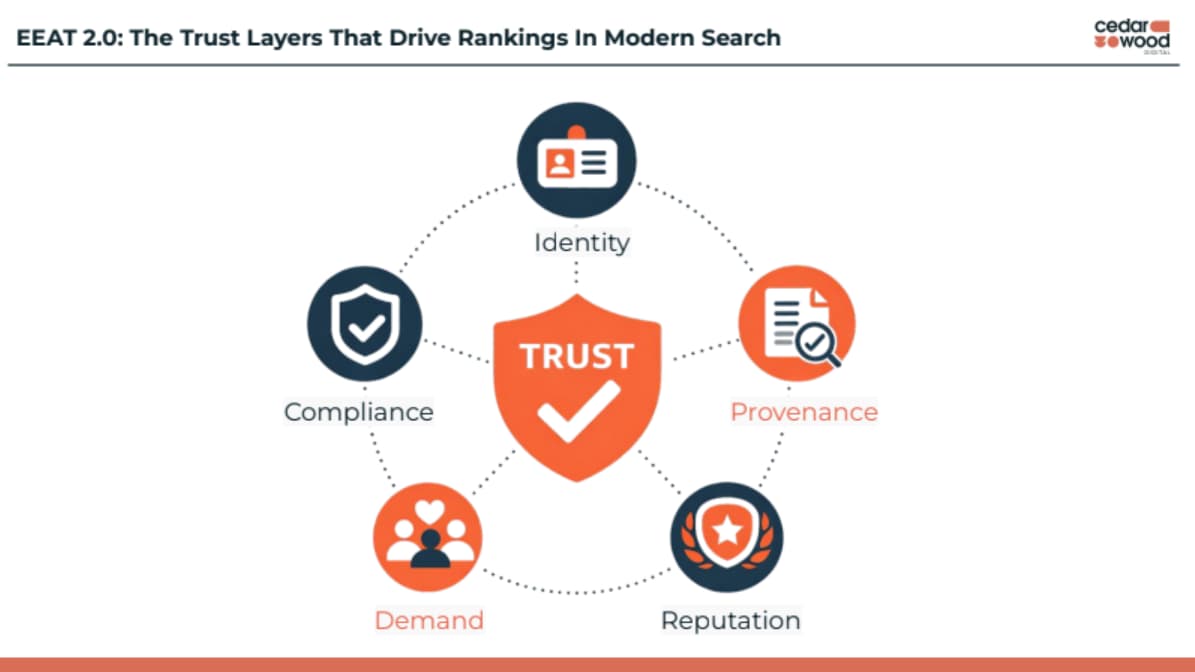
AI platforms don’t evaluate your credibility by reading your About page. They infer it from the pattern of signals across the entire web – every platform where you appear, every mention of your brand, every review, every piece of press coverage, every comment thread where your name comes up. Sean Barber, SEO Manager at Macmillan Cancer Support, put it memorably: AI infers credibility from patterns across the web, not necessarily from truth. If the pattern says your brand is credible, trustworthy, and authoritative, the AI’s representation of you will reflect that, regardless of how polished your website is.
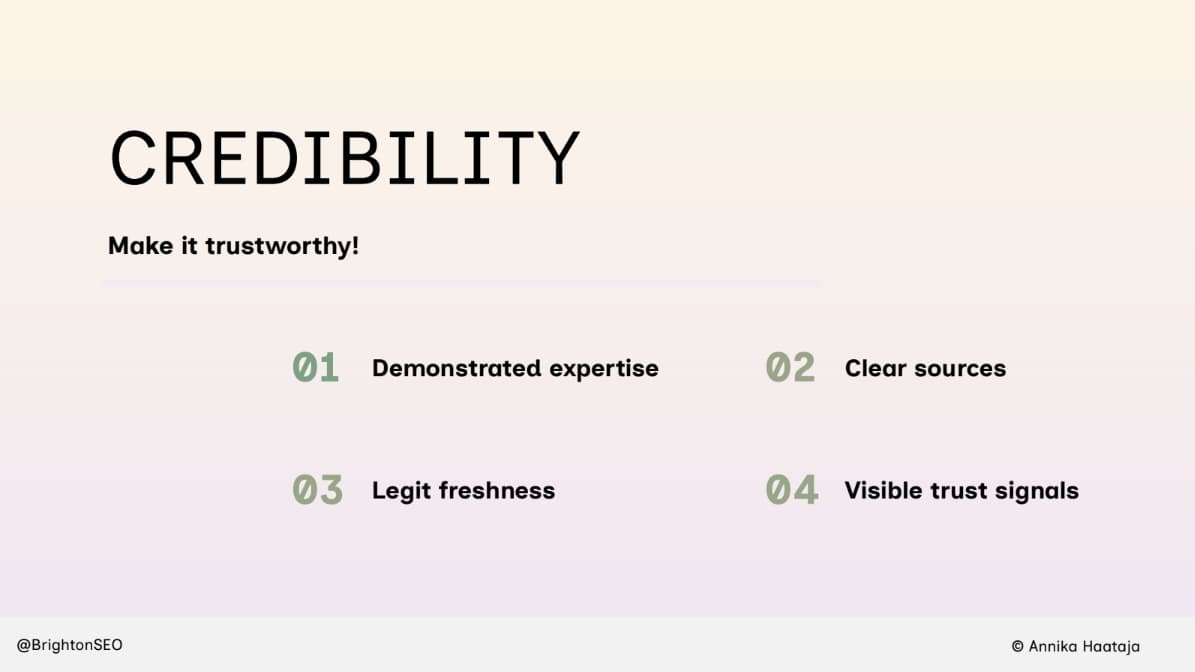
The inverse is equally true, and it’s more unsettling. Annika Haataja, SEO and Content Manager at ADP reinforced that E-E-A-T signals must be visible and consistent across every channel and content format – not just your website, but your social profiles, your video content, your listing in industry directories, and the coverage written about you by others. An impressive website surrounded by thin, inconsistent, or absent signals everywhere else is a weak E-E-A-T profile.
The Brand Narrative Problem Most Businesses Don’t Know They Have
At the Digital PR Summit, Paul attended Michael Bates’ session from Herd – one of the most practically challenging talks of the entire trip, because it forced a clear-eyed look at something most brands assume they’ve got under control.
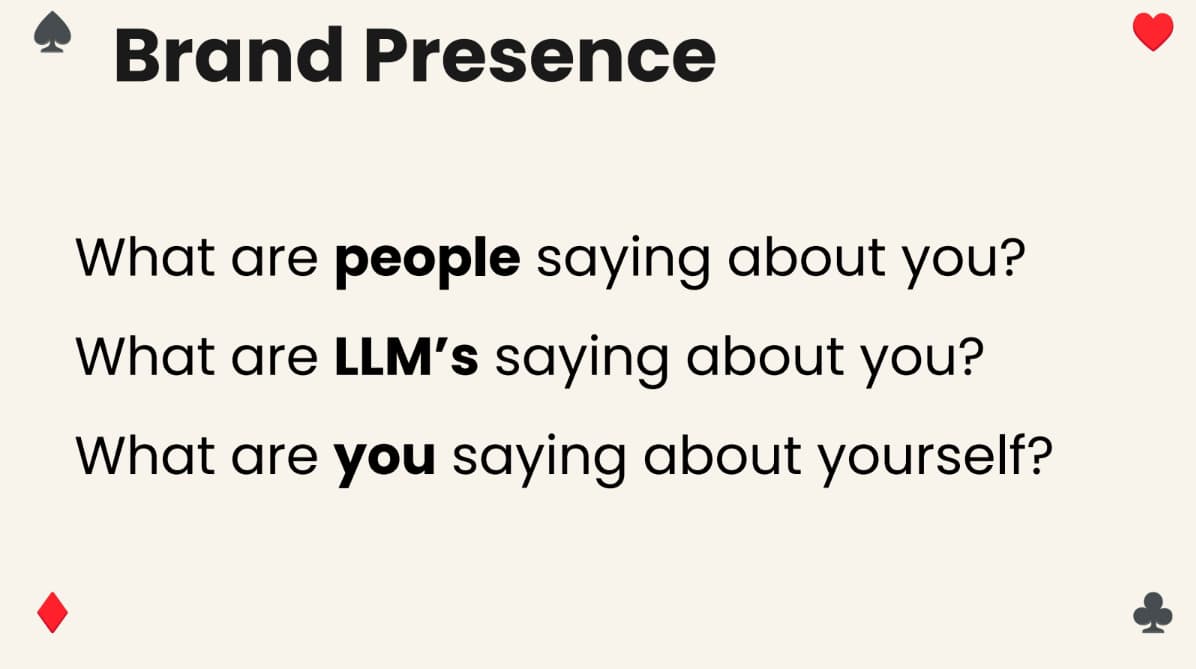
Michael’s argument: in a world where AI aggregates everything written about you, your brand narrative is no longer what you say about yourself – it’s the average of everything that has been said about you, everywhere, by everyone. Your website can tell a perfectly crafted story. But if your press coverage contradicts it, your reviews undermine it, your social presence is inconsistent with it, and your AI-generated description is a muddy compromise between all of them – then your brand narrative, in the place that increasingly matters most, is a mess.
He demonstrated a brand narrative matrix: a systematic audit of how a brand is described across its own channels (website, social, marketing materials), earned channels (press coverage, editorial mentions), owned-but-not-controlled channels (Google Business Profile, Wikipedia, directories), and user-generated channels (reviews, Reddit, forums). The exercise, when applied honestly, almost always reveals significant inconsistency – not because brands are being dishonest, but because different channels evolved over time without coordination.
The importance of this for AI visibility is direct. As we covered in our post on AI brand mentions, the entity confidence score – the degree of certainty an AI model has about who you are and what you offer – is built from consistency. A brand narrative that is coherent and consistent across all channels will score higher. A brand whose story changes depending on which platform you’re reading will score lower.
Paul’s take:“Michael’s session was one of the few that actually made me feel slightly uncomfortable about our own work, because I could think of clients immediately where this exercise would reveal real inconsistencies. The good news is that the audit itself is something we can run relatively quickly, and the findings give us a clear, prioritised action list. It’s one of the things we’re building into our onboarding process for new clients.”
Why Digital PR Is Now an SEO Discipline
James Roach’s session at the Digital PR Summit made an argument that felt important enough to write down in full: digital PR in 2026 is not a separate channel from SEO. It is SEO conducted outside your own website.
Every piece of press coverage that mentions your brand is a third-party citation. Every editorial roundup that includes your product is an entity signal. Every journalist who quotes your CEO as an expert source is an E-E-A-T signal. Every link back to your website from a credible publication is, still, one of the most powerful ranking signals that exists.
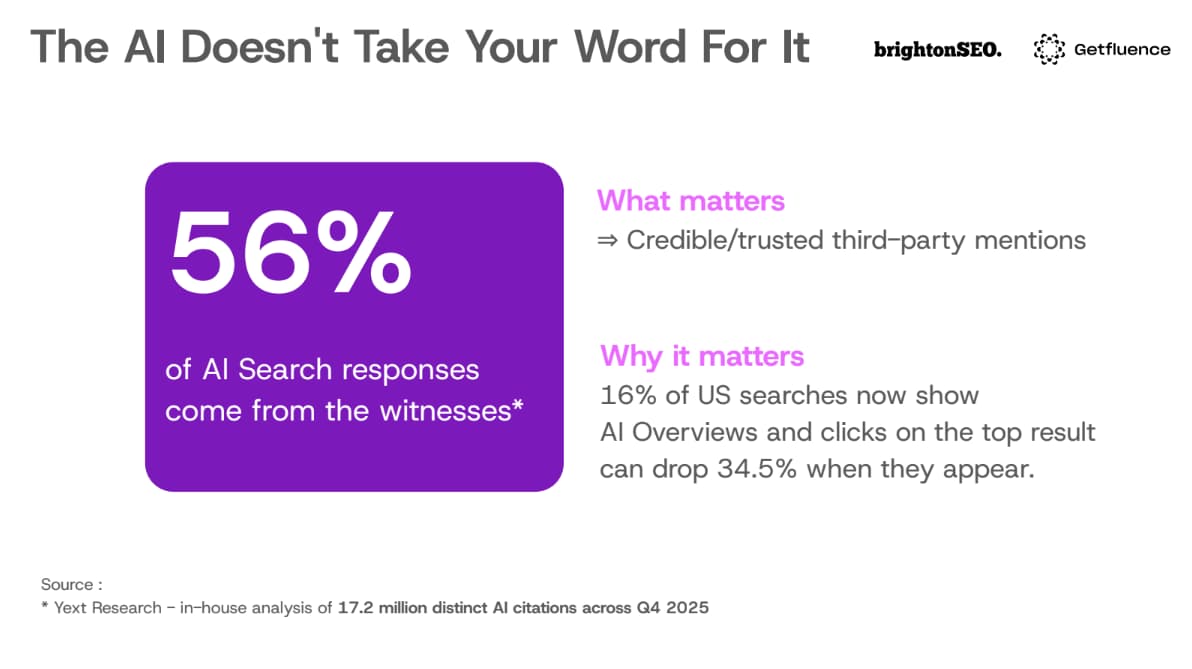
But the value of all of this has expanded beyond links, in a way that would have been difficult to predict even two or three years ago. Christian Desert’s data from his BrightonSEO session is the number to keep in mind: 56% of AI visibility influence comes from external sources. When a user asks ChatGPT whether your brand is trustworthy, a significant portion of the answer is built from what has been written about you by people who are not you. Press coverage, editorial mentions, industry directory profiles, third-party reviews – these are the raw material from which AI constructs its picture of your brand.
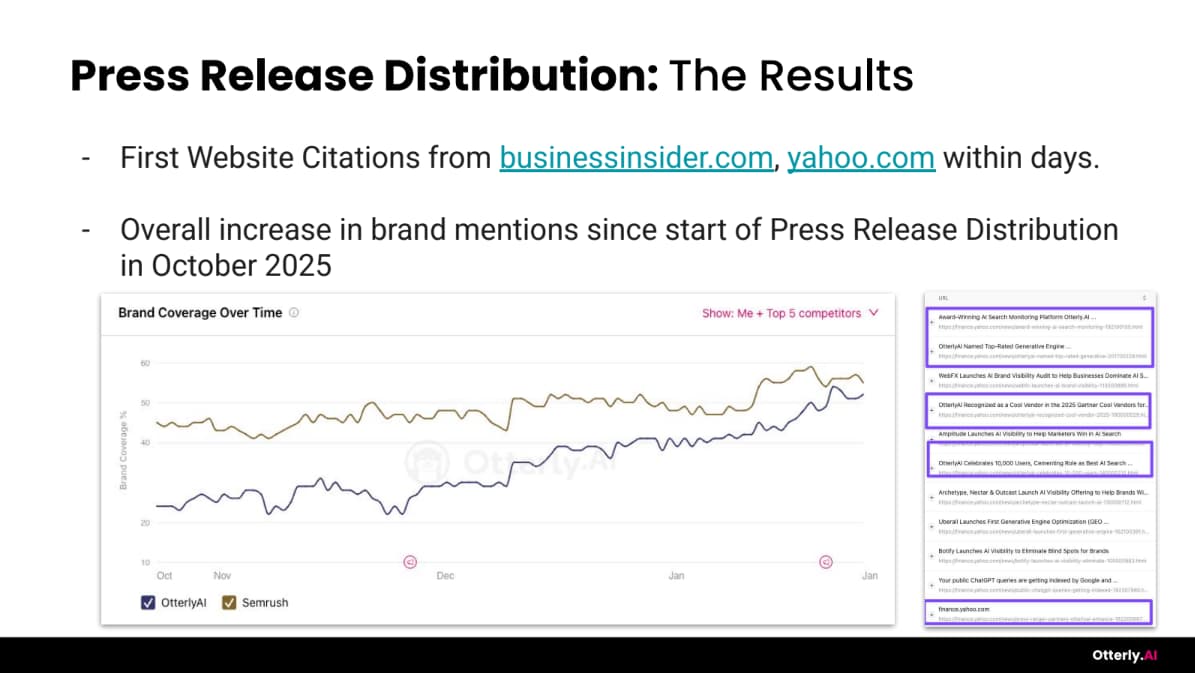
Thomas Peham from Otterly’s controlled testing added something specific and actionable to this picture: he found that distributing press releases to trusted media outlets produced measurable AI citation uplift within days of publication. Not weeks. Not months. Days. The AI learning cycle is faster than most people assume, at least for content that appears in sources the model already treats as authoritative.
Original Data: The PR Strategy That Actually Cuts Through
Multiple speakers at both events converged on the same conclusion about what makes a PR story land in 2026: original data is the only truly irreplaceable asset.
Madeleine Lambert from Originality.ai, whose session at BrightonSEO was titled around data creativity in digital PR, set the scene clearly. Traditional PR is saturated. Journalists are overwhelmed with pitches, press releases, and AI-generated content. The stories that land are the ones that bring something nobody else has: an exclusive finding, a counterintuitive statistic, an answer to a question that everyone has wondered about but nobody has measured.

George Sinnott built on this with a framework that Paul has been thinking about in the context of several of our clients. His principle: start with a question people suspect the answer to, but that nobody has actually measured. Then find the data that answers it. The best PR campaigns don’t start with a dataset – they start with a hypothesis. What would be surprising? What would be useful? What, if confirmed, would genuinely change how people think about something?
The stories that perform best with journalists, George explained, share five characteristics: they are relatable (relevant to a wide audience, not just industry insiders), visual (they can be expressed in a chart, a map, or an infographic), quantified (there’s a specific number, not a vague trend), surprising (the finding is not what you’d assume), and tied to real consumer impact (it affects people’s lives or decisions in a tangible way).
Sacha Fournier brought this down to earth practically, demonstrating how to build a data-driven PR campaign without a developer, using publicly available app data and a tool called ClawCode to extract and analyse it in under 30 minutes. The barrier to data-driven PR, she argued, is lower than most businesses think. If you have customer purchase data, search trend data from your own analytics, regional performance data, or any kind of proprietary insight from running your business — you have the raw material for a data PR story.
Paul’s take:“Ganesh Sankar’s session on geospatial data for regional digital PR was one I hadn’t anticipated being as useful as it turned out to be. He showed how you can use postcode-level public data from sources like ONS and OpenStreetMap to create locally specific, regionally shareable PR stories – ‘the coldest suburbs in New Zealand’ or ‘the most congested roads in Auckland during school holidays.’ Free data, genuinely shareable stories. For location-based clients, this is a ready-made PR framework.”
Hyper-Targeted Outreach Beats Mass Emailing. It’s Not Even Close.
One of the most practically useful statistics from the Digital PR Summit came from Vince Nero at BuzzStream, and it’s the kind of finding that should change the way you approach media outreach if you’re currently doing any at all.
His research showed that smaller, hyper-targeted PR outreach campaigns of 25 to 50 highly personalised emails yield 17 times more links than mass email blasts of thousands. Seventeen times. Not 17%. Seventeen times more effective.
This is a finding worth sitting with for a moment, because it runs counter to the instinct many businesses have when they think about PR – which is to cast as wide a net as possible and hope something catches. The data says the opposite approach is dramatically more effective: identify the 25 to 50 journalists, editors, and content creators who have actually covered your category recently, whose audience overlaps with your target customer, and who have shown an interest in the kind of story you’re pitching. Personalise your outreach to each of them. Send 50 carefully crafted pitches rather than 2,000 generic ones.
Amanda Walls’ session on Custom GPTs for PR automation is directly relevant here. She’s built a suite of AI tools that automate the research-intensive parts of this process: journalist profiling (finding who has published what, recently, on which topics), coverage scanning (identifying which publications are already covering your category), and outreach personalisation (tailoring pitch angles to the specific journalist’s recent work). The combination of hyper-targeted strategy and AI-assisted research removes the main reason most brands give for not doing this kind of targeted PR: it takes too long.
Product PR Is Now an AI Visibility Strategy for E-Commerce and Retail Brands
This was a theme from the Digital PR Summit that Paul flagged specifically for several of our retail and e-commerce clients, and it’s worth explaining clearly because it represents a fairly significant reframe of what “product PR” is for.
Amy Gibson’s session at the Digital PR Summit demonstrated how editorial product roundups – the “10 best gifts under $100” or “the most stylish homeware for 2026” type of content – are now one of the most heavily cited content formats in AI product query responses. When someone asks ChatGPT “what’s a good jewellery gift for a 30th birthday?” the AI is drawing on exactly these kinds of editorial roundup articles from trusted publications to construct its answer.
This means securing product placement in relevant editorial roundups isn’t just about PR coverage anymore. It’s about AI visibility for product queries. A brand featured in a well-regarded gift guide on a trusted lifestyle publication is a brand whose products are more likely to be cited by AI when someone asks for a recommendation in that category.
Amy’s framework for making this happen: develop a tailored media list specifically of journalists who have published relevant editorial roundups in the last 90 days; identify which AI platforms are returning those roundups as sources for product queries in your category; craft a pitch that is personalised to the journalist’s specific angle and audience; and support the pitch with samples where possible. The conversion rate on a targeted, sample-supported pitch to the right journalist is dramatically higher than a generic press release.
Reviews: The Brand Management Discipline That Most Businesses Are Getting Wrong
We touched on reviews in our earlier post on AI brand mentions, but given how many sessions at both events returned to this topic, it deserves fuller treatment here.
The core message – from Sam Davis, Janaina Barreto-Romero, and multiple Digital PR Summit panellists – is that your reviews are not just a customer service metric. They are an AI visibility and brand authority asset.
Here’s why this reframe matters. Most businesses think about reviews reactively: a bad review appears, they respond (or don’t), life goes on. But from an AI visibility perspective, your reviews are live, public, persistently cited documents that AI models are actively reading and incorporating into their understanding of your brand. A three-star review from 2022 complaining about slow delivery is potentially part of what an AI cites today when someone asks “is [your brand] reliable?”
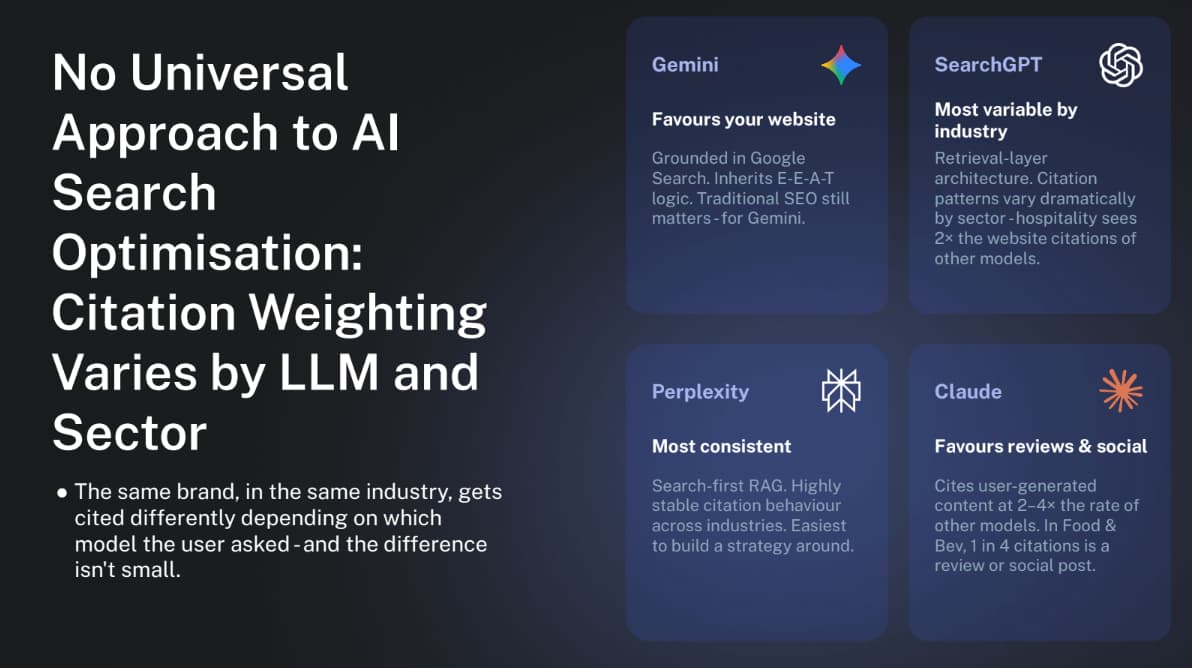
Sam Davis from Yext’s specific point about Claude – that it places particular weight on review response cadence as a trust signal for local and product queries – is one that surprised many people in the room. It’s not just whether you have reviews. It’s whether you respond to them, how consistently, and how quickly. A brand that responds to every review within 48 hours, professionally and personally, is signalling something about how it operates, and AI models are picking that up.
The old reviews problem is the one that generates the most unease when we share it with clients. Janaina Barreto-Romero from Oncrawl’s finding – that AI systems still cite old reviews, including very old ones – means that reviews you may have written off as historical are potentially still shaping what AI tells potential customers about you right now. Before you can build forward, it’s worth going back: reviewing every outstanding response, correcting factual inaccuracies where possible, and ensuring that the most recent pattern of reviews is as positive and well-managed as possible.
Paul’s take:“James Roach at the Digital PR Summit made a point about authenticity in expert sourcing that connects to this. He said AI and journalists alike now detect generic, fabricated personas and expert commentary. The brands that earn coverage and citations are the ones where real people with genuine expertise are speaking publicly – whether through interviews, guest commentary, social posts, or video. That’s a prompt for us to think about how we help clients build genuine expert profiles, not just review scores.”
Personal Branding at Leadership Level: The Organic Growth Lever Nobody Talks About
The Digital PR Summit included a session that doesn’t fit neatly into any of the technical SEO categories but that Paul flagged as one of the most commercially relevant conversations from the whole trip.
Ash Jones from Great Influence made the case for personal branding at leadership level as an organic growth strategy, using Steven Bartlett as the proof of concept. His argument: in an environment where AI is aggregating everything written about your brand, the people behind the brand are one of the most powerful differentiation signals available. A founder or director who speaks publicly, publishes thought leadership, appears in podcasts and panels, and builds a genuine professional profile is generating a stream of E-E-A-T signals that no amount of website optimisation can replicate.
This isn’t about becoming an influencer. It’s about the specific and measurable impact that leadership visibility has on brand credibility, particularly in service businesses, professional services, and categories where trust is a primary purchase driver. LinkedIn authority content, conference speaking, guest appearances on relevant podcasts or YouTube channels: these things generate citations, build entity prominence, and signal expertise in ways that compound over time.
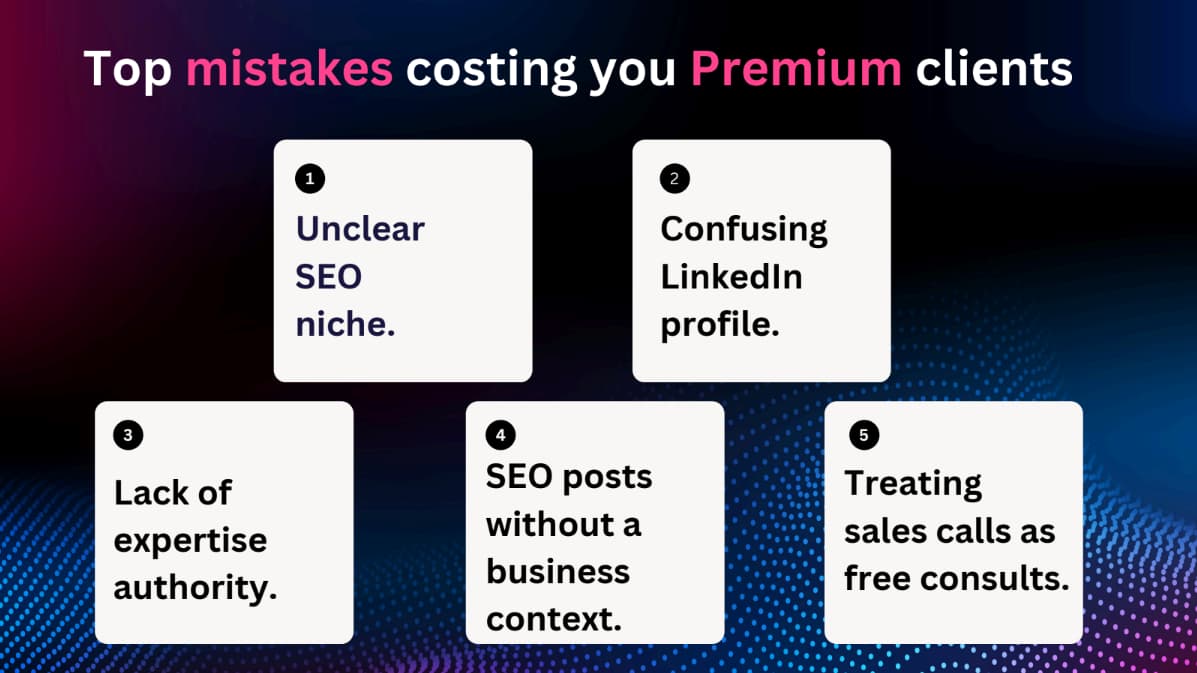
Adrijana Vujadin’s complementary session from Day 2 specifically focused on LinkedIn as a client acquisition channel for professional services firms. Her framework – building niche authority, publishing content that diagnoses real problems without giving away all the solutions, and engaging genuinely in professional communities – maps directly onto the E-E-A-T signals that both Google and AI platforms reward.
What This All Looks Like in Practice: Five Steps to Getting Talked About
This has been a post full of strategy and data, so let me bring it down to the concrete. Here are five actions that most businesses, regardless of size or budget, can take to improve their brand authority and AI visibility:
- Run a brand narrative audit. Open your website, your Google Business Profile, your LinkedIn, and your top three review platforms. Ask honestly: is the same story being told consistently across all of them? Are the brand name, key values, and core offering described in the same way, in the same language? If not, start there, because inconsistency is the thing that most suppresses entity confidence.
- Respond to every outstanding review, and build a cadence for new ones. Go back through your review history and respond to anything unanswered. Then build a process – whether that’s a post-purchase email, a follow-up call, or a prompt at point of delivery – that generates a consistent flow of new reviews, particularly on Google and any sector-specific platform your audience uses.
- Identify one data story you could tell. Think about the data you hold that nobody else does: customer purchase patterns, seasonal trends, regional performance differences, before-and-after results. Apply George Sinnott’s test: is it relatable, visual, quantified, surprising, and tied to real consumer impact? If yes, you have the foundation of a PR story worth pitching.
- Build a media list of 25 to 50 targeted journalists or content creators who have recently published content in your category. Read what they’ve written. Understand their angle and audience. Reach out personally, with a pitch that is specifically relevant to what they cover. The response rate will be dramatically higher than any mass outreach approach.
- Make your expertise visible. Add author credentials to every piece of content your team produces. Encourage your leadership to publish on LinkedIn. Look for opportunities to comment publicly as an expert, whether through media requests (services like Help a Reporter Out can connect you with journalists looking for expert sources), podcast appearances, or guest posts on relevant industry publications.
If any of this feels like more than you have capacity to take on alone, this is exactly the kind of work we can help with. We’ve come back from Brighton with a clear view of what the PR and authority landscape looks like right now, and we’re actively building these frameworks into the work we do for clients.
Coming Up: The Final Post in the Series
In our final post, we’ll tackle the measurement question – how to prove the value of SEO and brand-building work in a world where clicks are declining and traditional attribution is increasingly unreliable. We’ll cover the frameworks for reporting on business impact rather than just traffic, the tools worth considering, and the conversation we think every brand should be having with its agency about what “success” looks like in 2026.
Gavin is Digital Hothouse’s SEO lead. He attended BrightonSEO 2026 with Director Paul Thornton, who also attended the Digital PR Summit the week prior.